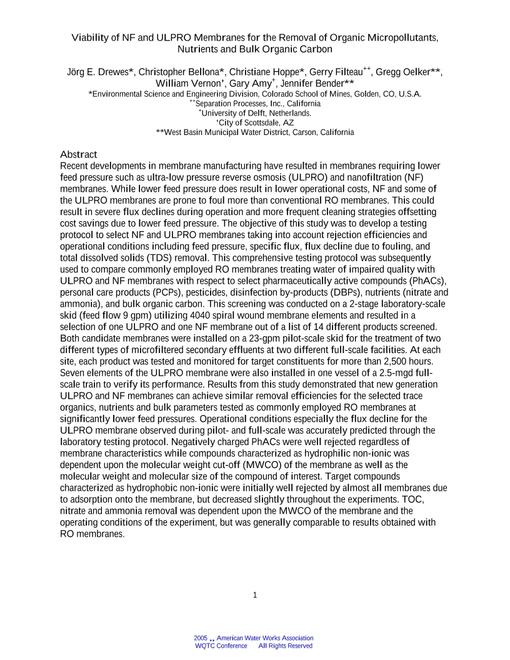
The objective of this study was to develop a testing
protocol to select nanofiltration (NF) and ultra-low pressure reverse osmosis (ULPRO) membranes taking into account rejection efficiencies and
operational conditions including feed pressure, specific flux, flux decline due to fouling, and
total dissolved solids (TDS) removal. This comprehensive testing protocol was subsequently
used to compare commonly used reverse osmosis (RO) membranes treating water of impaired quality with
ULPRO and NF membranes with respect to select pharmaceutically active compounds (PhACs),
personal care products (PCPs), pesticides, disinfection byproducts (DBPs), nutrients (nitrate and
ammonia), and bulk organic carbon. This screening was conducted on a 2-stage laboratory-scale
skid (feed flow 9 gpm) utilizing 4040 spiral wound membrane elements and resulted in a
selection of one ULPRO and one NF membrane out of a list of 14 different products screened.
Both candidate membranes were installed on a 23-gpm pilot-scale skid for the treatment of two
different types of microfiltered secondary effluents at two different full-scale facilities. At each
site, each product was tested and monitored for target constituents for more than 2,500 hours.
Seven elements of the ULPRO membrane were also installed in one vessel of a 2.5-mgd full-scale
train to verify its performance. Results from this study demonstrated that new generation
ULPRO and NF membranes can achieve similar removal efficiencies for the selected trace
organics, nutrients and bulk parameters tested as commonly employed RO membranes at
significantly lower feed pressures. Operational conditions especially the flux decline for the
ULPRO membrane observed during pilot- and full-scale was accurately predicted through the
laboratory testing protocol. Negatively charged PhACs were well rejected regardless of
membrane characteristics while compounds characterized as hydrophilic non-ionic was
dependent upon the molecular weight cut-off (MWCO) of the membrane as well as the
molecular weight and molecular size of the compound of interest. Target compounds
characterized as hydrophobic non-ionic were initially well rejected by almost all membranes due
to adsorption onto the membrane, but decreased slightly throughout the experiments. TOC,
nitrate and ammonia removal was dependent upon the MWCO of the membrane and the
operating conditions of the experiment, but was generally comparable to results obtained with RO membranes. Includes 8 references, tables, figure.
| Edition : | Vol. - No. |
| File Size : | 1
file
, 180 KB |
| Note : | This product is unavailable in Ukraine, Russia, Belarus |
| Number of Pages : | 8 |
| Published : | 11/01/2005 |