Since the new Groundwater Catchment Regulation in 2002 was published
in the Province of Quebec, it is now mandatory for municipalities to
describe the wellhead catchment areas to protect their water sources, a
considerable challenge for small municipalities. Utilities with groundwater
sources are thus required to describe the characteristics of their aquifers
and to identify the entire zone of contribution (ZOC) for wells as well as
the groundwater time-of-travel boundaries.
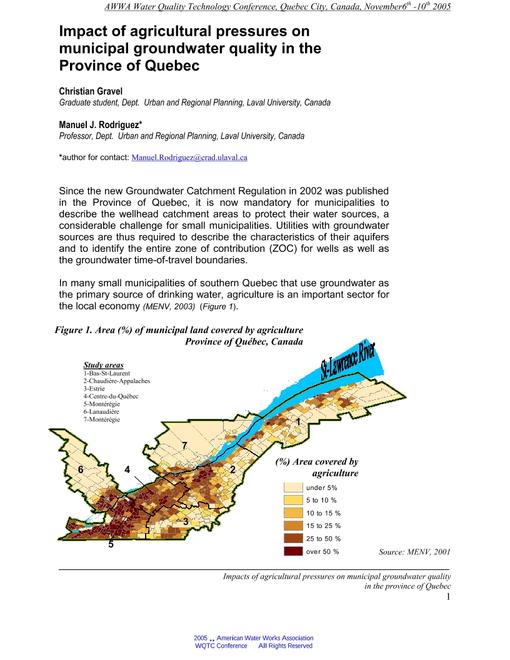
In many small municipalities of southern Quebec that use groundwater as
the primary source of drinking water, agriculture is an important sector for
the local economy (MENV, 2003). It is consequently important to assess
the impact of agricultural pressures on
groundwater quality to promote better
practices in locations close to the
municipal wells. This investigation sets
as a research hypothesis that the
quality of drinking water provided by
municipal wells is under influence of
intensive agricultural practices around
the wells. The study area includes
seven administration regions of the
Province of Quebec, that is about 600
municipal wells. ZOC for wells were
generated based on a local watershed
generation method from a digital
elevation model. This
regional analysis is different from the
approach used in other studies
conducted before because it proposes
the application of a specific spatial unit
(ZOC) for each well instead of using
fixed radius (Tesoriero and Voss, 1997;
Rupert, 2003; Nolan et al., 2002; Rasmussen
and Rouleau, 2003). Includes 10 references, figures.
| Edition : | Vol. - No. |
| File Size : | 1
file
, 2.5 MB |
| Note : | This product is unavailable in Ukraine, Russia, Belarus |
| Number of Pages : | 6 |
| Published : | 11/01/2005 |