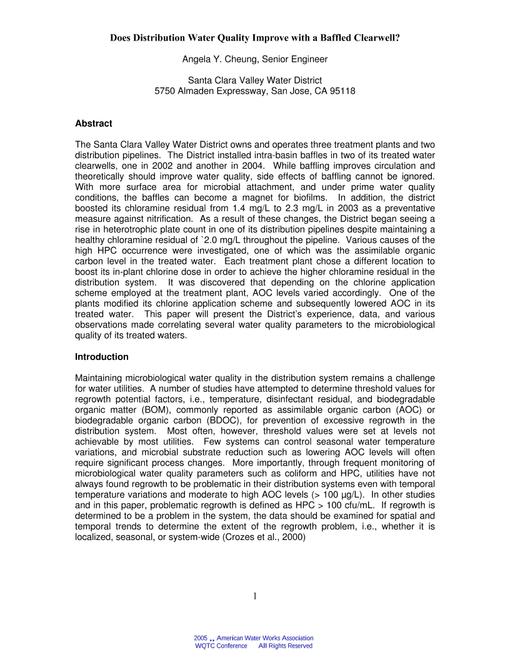
The Santa Clara Valley Water District owns and operates three treatment plants and two
distribution pipelines. The District installed intra-basin baffles in two of its treated water
clearwells, one in 2002 and another in 2004. While baffling improves circulation and
theoretically should improve water quality, side effects of baffling cannot be ignored.
With more surface area for microbial attachment, and under prime water quality
conditions, the baffles can become a magnet for biofilms. In addition, the district
boosted its chloramine residual from 1.4 mg/L to 2.3 mg/L in 2003 as a preventative
measure against nitrification. As a result of these changes, the District began seeing a
rise in heterotrophic plate count (HPC) in one of its distribution pipelines despite maintaining a
healthy chloramine residual of 2.0 mg/L throughout the pipeline. Various causes of the
high HPC occurrence were investigated, one of which was the assimilable organic
carbon (AOC) level in the treated water. Each treatment plant chose a different location to
boost its in-plant chlorine dose in order to achieve the higher chloramine residual in the
distribution system. It was discovered that depending on the chlorine application
scheme employed at the treatment plant, AOC levels varied accordingly. One of the
plants modified its chlorine application scheme and subsequently lowered AOC in its
treated water. This paper presents the District's experience, data, and various
observations made correlating several water quality parameters to the microbiological
quality of its treated waters. Includes 5 references, tables, figures.
| Edition : | Vol. - No. |
| File Size : | 1
file
, 1.2 MB |
| Note : | This product is unavailable in Ukraine, Russia, Belarus |
| Number of Pages : | 14 |
| Published : | 11/01/2005 |