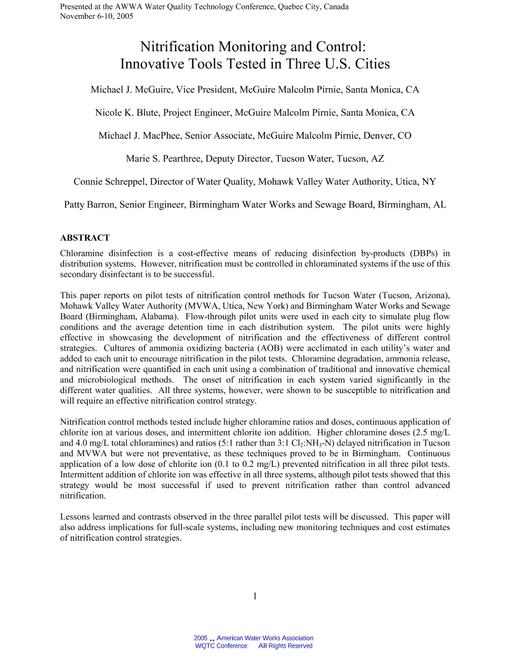
This paper reports on pilot tests of nitrification control methods for Tucson Water (Tucson, Arizona),
Mohawk Valley Water Authority (MVWA, Utica, New York) and Birmingham Water Works and Sewage
Board (Birmingham, Alabama). Flow-through pilot units were used in each city to simulate plug flow
conditions and the average detention time in each distribution system. The pilot units were highly
effective in showcasing the development of nitrification and the effectiveness of different control
strategies. Cultures of ammonia oxidizing bacteria (AOB) were acclimated in each utility's water and
added to each unit to encourage nitrification in the pilot tests. Chloramine degradation, ammonia release,
and nitrification were quantified in each unit using a combination of traditional and innovative chemical
and microbiological methods. The onset of nitrification in each system varied significantly in the
different water qualities. All three systems, however, were shown to be susceptible to nitrification and
will require an effective nitrification control strategy.
Nitrification control methods tested include higher chloramine ratios and doses, continuous application of
chlorite ion at various doses, and intermittent chlorite ion addition. Higher chloramine doses (2.5 mg/L
and 4.0 mg/L total chloramines) and ratios (5:1 rather than 3:1 Cl2:NH3-N) delayed nitrification in Tucson
and MVWA but were not preventative, as these techniques proved to be in Birmingham. Continuous
application of a low dose of chlorite ion (0.1 to 0.2 mg/L) prevented nitrification in all three pilot tests.
Intermittent addition of chlorite ion was effective in all three systems, although pilot tests showed that this
strategy would be most successful if used to prevent nitrification rather than control advanced
nitrification.
Lessons learned and contrasts observed in the three parallel pilot tests are discussed, and the paper
also addresses implications for full-scale systems, including new monitoring techniques and cost estimates
of nitrification control strategies. Includes 9 references, tables, figures.
| Edition : | Vol. - No. |
| File Size : | 1
file
, 640 KB |
| Note : | This product is unavailable in Ukraine, Russia, Belarus |
| Number of Pages : | 18 |
| Published : | 11/01/2005 |