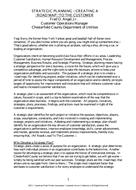
This paper discusses the importance of strategic planning in creating
a strategic perspective for an organization and a vision for the future, which will give you a
competitive advantage, and the right tools to take the necessary actions to keep your
organization profitable and successful. The purpose of a strategic plan is to create a
"road map" for identifying projects and/or initiatives, which can be implemented over a
period of time to assess the major components of an organization and to identify principle
targets of opportunity for improvement and innovation that will enhance customer value
and lead to increased customer satisfaction.
The paper explains how a strategic plan is an assessment of the organization, which must be comprehensive in
nature, focused in scope, and is a top to bottom examination of the way that the
organization does business. All projects, initiatives,
strategies, plans, processes, findings, and actions must be examined in light of the
customer's requirements.
A strategic plan identifies for each project or initiative the purpose, objectives, players,
scope, assumptions, constraints, and risks involved in creating and implementing
strategic projects and initiatives. Adopting and implementing a strategic plan should
identify for an organization the key drivers of customer satisfaction, assess the
organization's performance, improve employee knowledge, skills, career advancement,
and morale, generate revenue, and implement process improvements.
| Edition : | Vol. - No. |
| File Size : | 1
file
, 780 KB |
| Note : | This product is unavailable in Ukraine, Russia, Belarus |
| Number of Pages : | 14 |
| Published : | 03/19/2003 |