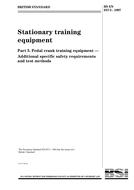
BS EN 957-5:1997 PDF

BS EN 957-5:1997 PDF

Name:
BS EN 957-5:1997 PDF

Published Date:
03/15/1997

Status:
Active

Description:

Stationary training equipment-Pedal crank training equipment. Additional specific safety requirements and test methods

Publisher:
British-Adopted European Standard

Document status:
Active

Format:
Electronic (PDF)

Delivery time:
10 minutes

Delivery time (for Russian version):
200 business days

SKU:

Choose Document Language:
$57.15
Need Help?


Cross References:
BS 5665:Part 1
BS EN 292-1
BS EN 292-2
BS EN 563
BS EN 957-1
ISO 4210

File Size : 1 file , 180 KB
ISBN(s) : 0580267199
Note : This product is unavailable in Ukraine, Russia, Belarus
Number of Pages : 18
Product Code(s) : 899563, 899563, 00899563
Published : 03/15/1997

History

BS 07/30165571 DC
Published Date: 07/16/2007
BS EN 957-5. Stationary training equipment. Part 5. Stationary exercise bicycles and upper body crank training equipment, additional specific safety requirements and test methods
BS EN 957-5:1997
Published Date: 03/15/1997
Stationary training equipment-Pedal crank training equipment. Additional specific safety requirements and test methods
$57.15

Related products


Best-Selling Products

SN-ISO/TR 10013:2001
Published Date: 01/14/2002
Guidelines for quality management system documentation
SN-ISO/TR 14062:2002
Published Date: 11/11/2002
Environmental management - Integrating environmental aspects into product design and development
SN-ISO/TR 14069:2013
Published Date: 06/11/2015
Greenhouse gases - Quantification and reporting of greenhouse gas emissions for organizations - Guidance for the application of ISO 14064-1
SN-ISO/TR 15489-2:2001
Published Date: 11/01/2008
Information and documentation — Records management — Part 2: Guidelines
SN-ISO/TR 15499:2012
Published Date: 07/01/2014
Biological evaluation of medical devices — Guidance on the conduct of biological evaluation within a risk management process
SN-ISO/TR 19083-1:2016
Published Date: 07/13/2023
Intelligent transport systems - Emergency evacuation and disaster response and recovery - Part 1: Framework and concept of operation