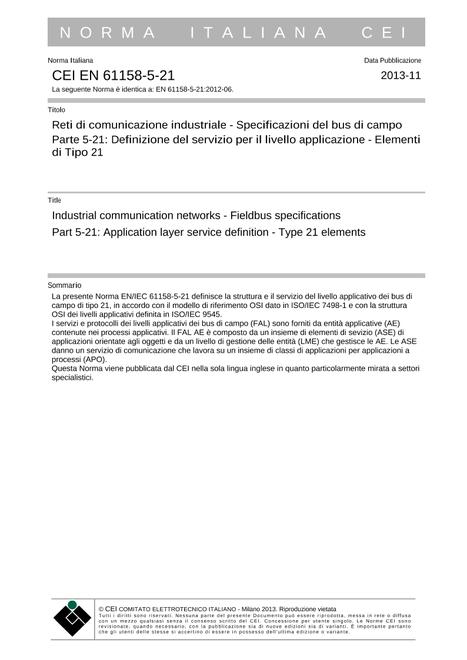
Name:
CEI EN 61158-5-21 PDF
Published Date:
11/01/2013
Status:
[ Revised ]
Publisher:
Comitato Elettrotecnico Italiano
Overview
The Fieldbus Application Layer (FAL) provides user programs with a means to access the fieldbus communication environment. In this respect, the FAL can be considered a window between corresponding application programs.
This standard provides the common elements for basic time-critical and non-time-critical messaging communications between application programs in an automation environment as well as material specific to the Type 21 protocol. The term "time-critical" is used to represent the presence of a time-window within which one or more specified actions are required to be completed with some defined level of certainty. Failure to complete specified actions within the time window risks failure of the applications requesting the actions, with attendant risk to equipment, plant, and possibly human life.
This standard defines, in an abstract way, the externally visible service provided by the FAL in terms of:
a) an abstract model for defining application resources (objects) capable of being manipulated by users via the FAL service;
b) the primitive actions and events of the service;
c) the parameters associated with each primitive action and event, and the form that they take;
d) the interrelationship between these actions and events, and their valid sequences. The purpose of this standard is to define the services provided to:
a) the FAL-user at the boundary between the user and the application layer of the fieldbus Reference Model;
b) systems management at the boundary between the application layer and systems management of the fieldbus Reference Model.
This standard describes the structure and services of the IEC FAL, in conformance with the OSI Basic Reference Model (ISO/IEC 7498) and the OSI Application layer Structure (ISO/IEC 9545).
FAL services and protocols are provided by FAL application entities (AEs) contained in the application processes. The FAL AE is composed of a set of object-oriented Application Service Elements (ASEs) and a Layer Management Entity (LME) that manages the AE. The ASEs provide communication services that operate on a set of related application process object (APO) classes. One of the FAL ASEs is a management ASE that provides a common set of services for management of the instances of FAL classes.
Although these services specify how requests and responses are issued and delivered from the perspective of applications, they do not include a specification of what the requesting and responding applications are to do with them. That is, these services only define what requests and responses applications can send or receive, not the functions of the applications themselves. This permits greater flexibility to the FAL-users in standardizing such object behavior. In addition to these services, some supporting services are also defined in this standard to provide access to the FAL to control certain aspects of its operation.
| Edition : | 13 |
| File Size : | 1 file , 1.2 MB |
| Number of Pages : | 80 |
| Published : | 11/01/2013 |


