Name:
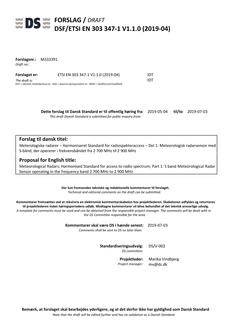
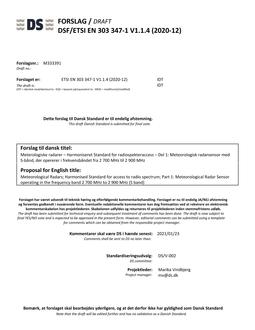
DANSK DSF/ETSI EN 303 347-1 V1.1.4 (2020-12) PDF
Published Date:
Status:
[ Draft-Obsolete ]
Publisher:
Dansk Standard
The present document specifies technical characteristics and methods of measurements for S-band meteorological radar systems intended for the surveillance and classification of hydrometeors with the following characteristics: • Operating in the following frequency range: - 2 700 MHz to 2 900 MHz. • Utilizing unmodulated pulses or phase/frequency modulated pulses also known as pulse compression. • The maximum output power (PEP) does not exceed 1 MW (i.e. 90 dBm). • The transceiver antenna connection and its feeding RF line are using a hollow metallic rectangular or elliptic waveguide. • The antenna is rotating and can be changed in elevation. • The antenna feed is waveguide based and the antenna is passive. • The orientation of the transmitted field from the antenna can be vertical or horizontal orientated or it can be both simultaneously. • At the transceiver output a RF circulator is used. NOTE 1: Since transceiver and antenna are based on hollow metallic rectangular waveguide the frequency range for measurements that needs to be addressed covers 2 077 MHz to 14 500 MHz. The lower limit of this frequency range is obtained as the cut-off frequency of the generally used WR284/WG10 waveguide according to IEC 60153-2 [i.2]. The upper limit corresponds to the upper limit stated in ERC/Recommendation 74-01, Table 1 [1]. The highest operating frequency of 2 900 MHz has been used to calculate the upper limit. NOTE 2: Since at the transceiver output a RF circulator is used, it is assumed that the transceiver characteristics remain independent from the antenna.
| Edition : | 20 |
| File Size : | 1 file , 1.5 MB |
| Number of Pages : | 40 |
| Product Code(s) : | DSF-036, DSF-036 |