Name:
FAA TSO C40C PDF
Published Date:
01/25/1988
Status:
[ Active ]
Publisher:
Federal Aviation Administration
Applicability.
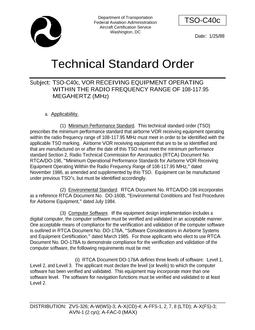
(1) Minimum Performance Standard. This technical standard order (TSO) prescribes the minimum performance standard that airborne VOR receiving equipment operating within the radio frequency range of 108-117.95 MHz must meet in order to be identified with the applicable TSO marking. Airborne VOR receiving equipment that are to be so identified and that are manufactured on or after the date of this TSO must meet the minimum performance standard Section 2, Radio Technical Commission for Aeronautics (RTCA) Document No. RTCA/DO-196, "Minimum Operational Performance Standards for Airborne VOR Receiving Equipment Operating Within the Radio Frequency Range of 108-117.95 MHz," dated November 1986, as amended and supplemented by this TSO. Equipment can be manufactured under previous TSO's, but must be identified accordingly.
(2) Environmental Standard. RTCA Document No. RTCA/DO-196 incorporates as a reference RTCA Document No. DO-160B, "Environmental Conditions and Test Procedures for Airborne Equipment," dated July 1984.
(3) Computer Software. If the equipment design implementation includes a digital computer, the computer software must be verified and validated in an acceptable manner. One acceptable means of compliance for the verification and validation of the computer software is outlined in RTCA Document No. DO-178A, "Software Considerations in Airborne Systems and Equipment Certification," dated March 1985. For those applicants who elect to use RTCA Document No. DO-178A to demonstrate compliance for the verification and validation of the computer software, the following requirements must be met:
(i) RTCA Document DO-178A defines three levels of software: Level 1, Level 2, and Level 3. The applicant must declare the level (or levels) to which the computer software has been verified and validated. This equipment may incorporate more than one software level. The software for navigation functions must be verified and validated to at least Level 2.
(ii) The applicant must submit a software verification and validation plan for review and approval.
NOTE: The Federal Aviation Administration (FAA) strongly recommends early discussion and agreement between the applicant and the FAA on the applicant's proposed software verification and validation plan, and the applicant's proposed software level or levels.
| Edition : | C |
| File Size : | 1 file , 39 KB |
| Number of Pages : | 4 |
| Published : | 01/25/1988 |