Name:
FDA 21 CFR UCM 094461 PDF
Published Date:
07/18/2000
Status:
[ Active ]
Publisher:
Food and Drug Administration
Introduction
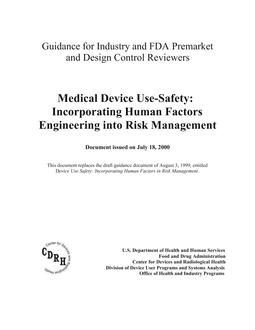
This guidance1 describes how hazards related to medical device use should be addressed during device development as part of the risk management process. Potential use-related hazards are best identified and addressed using human factors engineering (HFE)2. The process of incorporating these approaches in the risk management processes is explained. Documenting these efforts can demonstrate that the device manufacturer has undertaken efforts to control userelated hazards. The goal is to minimize use-related hazards, assure that intended users are able to use medical devices safely and effectively throughout the product life cycle, and to facilitate review of new device submissions and design control documentation.
Addressing use-related hazards should be undertaken within the context of a thorough understanding of how a device will be used. Essential components of this understanding include:
· Device users, (e.g., patient, family member, physician, nurse, professional caregiver)
· Typical and atypical device use,
· Device characteristics,
· Characteristics of the environments in which the device will be used, and
· The interaction between users, devices, and use environments.
Following a thorough understanding of device use, specific ways that devices could be used that are likely to result in hazards should be identified and investigated through analysis and testing. In addition to investigating known or suspected problems with device use, testing prototype devices with users can identify ways of using devices that could be hazard-related that were not anticipated. This is important because it is extremely difficult to identify all significant device use problems in advance.
After use-related hazards are understood, the hazards are mitigated or controlled by modifying the device user interface (e.g., control or display characteristics, logic of operation, labeling) or the abilities of users to use the device (e.g., training, limiting use to qualified users). The field of human factors provides a variety of useful approaches to help identify, understand, and address use-related problems.
This guidance does not focus on any specific kind of medical device, but applies to all medical devices and accessories that involve interaction with users (e.g., thought, perception, decisionmaking, and manipulation with hands). It is intended for medical device manufacturers, the Food and Drug Administration (FDA)’s Center for Devices and Radiological Health (CDRH) reviewers of pre-market submissions and design controls, and as a general reference for postmarket surveillance activities associated with use-related hazards. It is assumed that readers have some understanding of design controls, risk management and HFE. Some readers might find it helpful to review references 10, 16, 19, 28 and 33 listed in Section 7.0.
1 This document is intended to provide guidance. It represents the Agency’s current thinking on this topic. It does not create or confer any rights for or on any person and does not operate to bind FDA or the public. An alternative approach may be used if such approach satisfies the requirements of the applicable statute, regulations, or both.
2 The term Human Factors Engineering and its acronym (HFE) are used extensively in this document. On occasion the term Human Factors (HF) is also used. The two terms distinguish between application (HFE), and the scientific principles and academic research that provides the basis for it (HF).
| Edition : | 16 |
| File Size : | 1 file , 1.7 MB |
| Number of Pages : | 33 |
| Published : | 07/18/2000 |