Name:
FDA 21 CFR UCM 259748 PDF
Published Date:
02/03/2016
Status:
[ Active ]
Publisher:
Food and Drug Administration
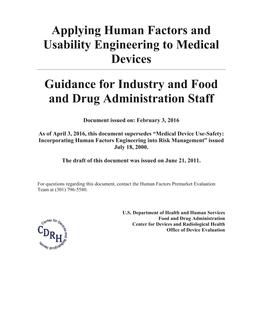
This guidance recommends that manufacturers follow human factors or usability engineering processes during the development of new medical devices, focusing specifically on the user interface, where the user interface includes all points of interaction between the product and the user(s) including elements such as displays, controls, packaging, product labels, instructions for use, etc. While following these processes can be beneficial for optimizing user interfaces in other respects (e.g., maximizing ease of use, efficiency, and user satisfaction), FDA is primarily concerned that devices are safe and effective for the intended users, uses, and use environments. The goal is to ensure that the device user interface has been designed such that use errors that occur during use of the device that could cause harm or degrade medical treatment are either eliminated or reduced to the extent POSSIBLE.
As part of their design controls1, manufacturers conduct a risk analysis that includes the risks associated with device use and the measures implemented to reduce those risks. ANSI/AAMI/ISO 14971, Medical Devices – Application of risk management to medical devices, defines risk as the combination of the probability of occurrence of harm and the severity of the potential harm2. However, because probability is very difficult to determine for use errors, and in fact many use errors cannot be anticipated until device use is simulated and observed, the severity of the potential harm is more meaningful for determining the need to eliminate (design out) or reduce resulting harm. If the results of risk analysis indicate that use errors could cause serious harm to the patient or the device user, then the manufacturer should apply appropriate human factors or usability engineering processes according to this guidance document. This is also the case if a manufacturer is modifying a marketed device to correct design deficiencies associated with use, particularly as a corrective and preventive action (CAPA).
CDRH considers human factors testing a valuable component of product development for medical devices. CDRH recommends that manufacturers consider human factors testing for medical devices as a part of a robust design control subsystem. CDRH believes that for those devices where an analysis of risk indicates that users performing tasks incorrectly or failing to perform tasks could result in serious harm, manufacturers should submit human factors data in premarket submissions (i.e., PMA, 510(k)). In an effort to make CDRH’s premarket submission expectations clear regarding which device types should include human factors data in premarket submissions, CDRH is issuing a draft guidance document List of Highest Priority Devices for Human Factors Review, Draft Guidance for Industry and Food and Drug Administration Staff (http://www.fda.gov/downloads/MedicalDevices/DeviceRegulationandGuidance/Guidanc eDocuments/UCM484097.pdf). When final, this document will represent the Agency’s current thinking on this issue.
| Edition : | 16 |
| File Size : | 1 file , 5.6 MB |
| Number of Pages : | 50 |
| Published : | 02/03/2016 |