Name:
GME GME8619 PDF
Published Date:
02/01/2016
Status:
[ Not for New Design ]
Publisher:
General Motors Europe
Introduction
Purpose. Determination of torque output, damp-ing, floating stop resistance and free stroke angle of tensioner to toothed belt drive.
Foreword. Not applicable.
Applicability. For all toothed belt drives.
Definitions.
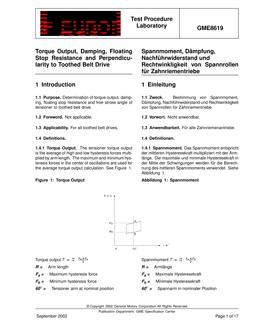
Torque Output. The tensioner torque output is the average of high and low hysteresis forces multi-plied by arm length. The maximum and minimum hys-teresis forces in the center of oscillations are used for the average torque output calculation.
Damping. Maximum and minimum hysteresis forces to be recorded for each position at the center of the oscillation. Specification for force variation to be established for each of 6 forces.
Floating Stop Torque Resistance. The float-ing stop torque resistance is considered to he the first peak of the measured force necessary to readjust the stop multiplied by the arm length. The full assembly shall be measured, so the floating stop torque resistance is mainly effected by 3 features:
• the primary spring torque
• friction between bushing and pivot shaft
• torque resistance of floating stop damping element
Free Stroke Angle. ihe tree stroke angle is the angle by which the tensioner arm shall be rotated from freearm until the hubload reaches 500 N.
Perpendicularity Measurement. Perpendicu-larity is the offset between the pulley actual position and perfectly perpendicular position represented by the gage block. The result of the measurement using the gage to be recalculated to the pulley width.
Note: Nothing in the specification, however, super-sedes applicable laws and regulations unless a spe-cific exemption has been obtained.
Note: In the event of a conflict between the German and the English language, the German language shall take precedence.
| Edition : | 2 |
| File Size : | 1 file , 3.8 MB |
| Number of Pages : | 17 |
| Published : | 02/01/2016 |