Name:
GMNA GM4350M PDF
Published Date:
12/01/2013
Status:
[ Not for New Design ]
Publisher:
General Motors North America
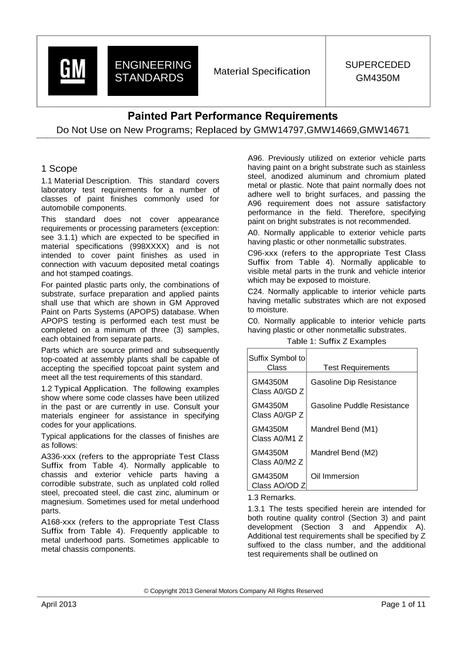
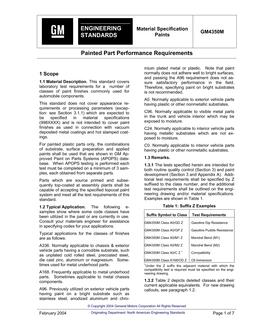
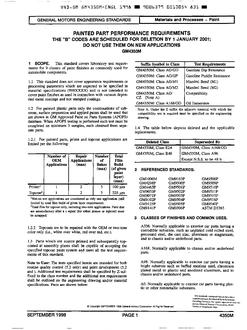
Material Description. This standard covers laboratory test requirements for a number of classes of paint finishes commonly used for automobile components.
This standard does not cover appearance requirements or processing parameters (exception: see 3.1.1) which are expected to be specified in material specifications (998XXXX) and is not intended to cover paint finishes as used in connection with vacuum deposited metal coatings and hot stamped coatings.
For painted plastic parts only, the combinations of substrate, surface preparation and applied paints shall use that which are shown in GM Approved Paint on Parts Systems (APOPS) database. When APOPS testing is performed each test must be completed on a minimum of three (3) samples, each obtained from separate parts.
Parts which are source primed and subsequently top-coated at assembly plants shall be capable of accepting the specified topcoat paint system and meet all the test requirements of this standard.
Typical Application. The following examples show where some code classes have been utilized in the past or are currently in use. Consult your materials engineer for assistance in specifying codes for your applications.
Typical applications for the classes of finishes are as follows:
A336-xxx (refers to the appropriate Test Class Suffix from Table 4). Normally applicable to chassis and exterior vehicle parts having a corrodible substrate, such as unplated cold rolled steel, precoated steel, die cast zinc, aluminum or magnesium. Sometimes used for metal underhood parts.
A168-xxx (refers to the appropriate Test Class Suffix from Table 4). Frequently applicable to metal underhood parts. Sometimes applicable to metal chassis components.
A96. Previously utilized on exterior vehicle parts having paint on a bright substrate such as stainless steel, anodized aluminum and chromium plated metal or plastic. Note that paint normally does not adhere well to bright surfaces, and passing the A96 requirement does not assure satisfactory performance in the field. Therefore, specifying paint on bright substrates is not recommended.
A0. Normally applicable to exterior vehicle parts having plastic or other nonmetallic substrates.
C96-xxx (refers to the appropriate Test Class Suffix from Table 4). Normally applicable to visible metal parts in the trunk and vehicle interior which may be exposed to moisture.
C24. Normally applicable to interior vehicle parts having metallic substrates which are not exposed to moisture.
Remarks.
The tests specified herein are intended for both routine quality control (Section 3) and paint development (Section 3 and Appendix A). Additional test requirements shall be specified by Z suffixed to the class number, and the additional test requirements shall be outlined on the engineering drawing and/or material specifications.
| Edition : | 19 |
| File Size : | 1 file , 240 KB |
| Number of Pages : | 11 |
| Published : | 12/01/2013 |