Name:
GMNA GM7400M PDF
Published Date:
12/01/2013
Status:
[ Not for New Design ]
Publisher:
General Motors North America
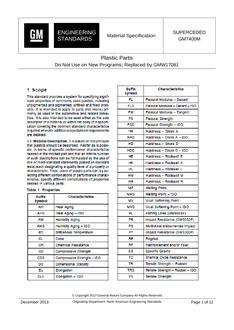
This standard provides a system for specifying significant properties of commonly used plastics, including unpigmented and pigmented, unfilled and filled products. It is intended to apply to parts (not resins) primarily as used in the automotive and related industries. It is also intended to be used either as the sole descriptor of a material or within the body of a specification covering the common standard characteristics required wherein additional specialized requirements are detailed.
Material Description. It is based on the principle that plastics should be described, insofar as is possible, in terms of specific performance characteristics desired in the molded part and that an infinite number of such descriptions can be formulated by the use of one or more standard statements (based on standard tests) each designating a quality level of a property or characteristic. Thus, users of plastic parts can, by selecting different combinations of performance characteristics, specify different combinations of properties desired in various parts.
Material Identification.
Marking Of Parts. Parts shall be marked using the latest version of ISO 11469. For example, polycarbonate would be indicated as follows:
> PC <
Marking is required on all plastic parts except in cases where fit, function, or appearance is compromised. Extruded parts are also excluded from this requirement.
A molded part that is manufactured using more than one polymer type shall have the plastic symbols for each polymer type identified on the part. Examples ofmanufacturing usingmore than one polymer type are coinjection molding and two-shot molding.
Note: The above does not include cases where blends or alloys are used, consult ISO 11469 for the correct symbol to use.
In cases where the letter height must be smaller than 1.5 mm in order to fit on the part, marking is not required. For ease of locating for recycling, make the marking as large as possible without hindering appearance or function.
Where possible, the ISO marking shall be located near the part number, cavity number, molding date, or other markings on the part. If there is not room near the other markings, or there are no other markings on the part, then the ISO marking shall be in an area that can be easily found when the part is disassembled from the vehicle.
Standard Drawing Notes. Mark all plastic parts per ISO 11469.
Cross-Reference of Replaced Specifications. Subparagraphs were not applicable.
Symbol. To permit line call-out of the descriptions mentioned, the system includes a symbol for the general type of plastic resin to be used and a letter- number symbol for each quality level of each property or characteristic.
Example: An automotive interior part might be specified as follows:
GM7400M ABS (DSB83, FM2200, RE20, SGE895, TSB46)
Note: While this cell type format provides the means for close characterization and specification of each property and combination of properties for a broad range of materials, it is subject to possible misapplications since impossible property combinations can be coded if the user is not familiar with available commercial materials.
Typical Application. Not applicable.
Remarks. Not applicable.
| Edition : | 11 |
| File Size : | 1 file , 680 KB |
| Number of Pages : | 12 |
| Published : | 12/01/2013 |
