Name:
GMNA GMN3922 PDF
Published Date:
03/01/2014
Status:
[ Not for New Design ]
Publisher:
General Motors North America
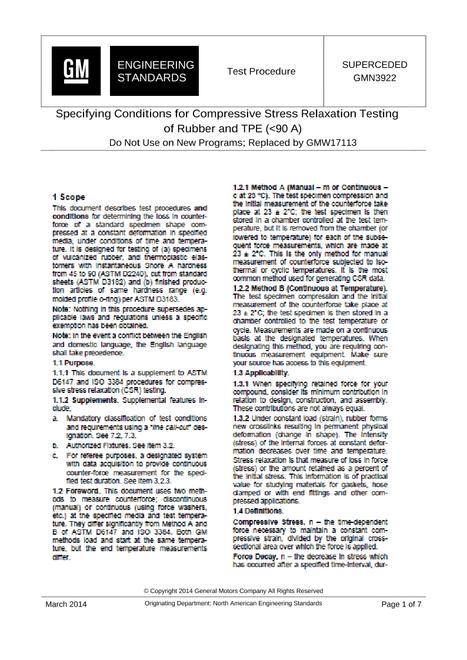
This document describes test procedures and conditions for determining the loss in counterforce of a standard specimen shape compressed at a constant deformation in specified media, under conditions of time and temperature. It is designed for testing of (a) specimens of vulcanized rubber, and thermoplastic elastomers with instantaneous Shore A hardness from 45 to 90 (ASTM D2240), cut from standard sheets (ASTM D3182) and (b) finished production articles of same hardness range (e.g. molded profile o-ring) per ASTM D3183.
Note: Nothing in this procedure supersedes applicable laws and regulations unless a specific exemption has been obtained.
Note: In the event a conflict between the English and domestic language, the English language shall take precedence.
Purpose.
This document is a supplement to ASTM D6147 and ISO 3384 procedures for compressive stress relaxation (CSR) testing.
Supplements. Supplemental features include;
a. Mandatory classification of test conditions and requirements using a "line call-out" designation. See 7.2, 7.3.
b. Authorized Fixtures. See item 3.2.
c. For referee purposes, a designated system with data acquisition to provide continuous counter-force measurement for the specified test duration. See item 3.2.3.
Foreword. This document uses two methods to measure counterforce; discontinuous (manual) or continuous (using force washers, etc.) at the specified media and test temperature. They differ significantly from Method A and B of ASTM D6147 and ISO 3384. Both GM methods load and start at the same temperature, but the end temperature measurements differ.
Method A (Manual – m or Continuous – c at 23 °C). The test specimen compression and the initial measurement of the counterforce take place at 23 ± 2°C; the test specimen is then stored in a chamber controlled at the test temperature, but it is removed from the chamber (or lowered to temperature) for each of the subsequent force measurements, which are made at 23 ± 2°C. This is the only method for manual measurement of counterforce subjected to isothermal or cyclic temperatures. It is the most common method used for generating CSR data.
Method B (Continuous at Temperature). The test specimen compression and the initial measurement of the counterforce take place at 23 ± 2°C; the test specimen is then stored in a chamber controlled to the test temperature or cycle. Measurements are made on a continuous basis at the designated temperatures. When designating this method, you are requiring continuous measurement equipment. Make sure your source has access to this equipment.
Applicability.
When specifying retained force for your compound, consider its minimum contribution in relation to design, construction, and assembly. These contributions are not always equal.
Under constant load (strain), rubber forms new crosslinks resulting in permanent physical deformation (change in shape). The intensity (stress) of the internal forces at constant deformation decreases over time and temperature. Stress relaxation is that measure of loss in force (stress) or the amount retained as a percent of the initial stress. This information is of practical value for studying materials for gaskets, hose clamped or with end fittings and other compressed applications.
Definitions.
Compressive Stress, n – the time-dependent force necessary to maintain a constant compressive strain, divided by the original crosssectional area over which the force is applied.
Force Decay, n – the decrease in stress which has occurred after a specified time-interval, during application of a constant deformation, expressed as a percentage of the stress at the commencement of that time-interval. (Stress relaxation is a synonym).
Thermoplastic Elastomer, n – See ASTM D883 definition.
| Edition : | 3 |
| File Size : | 1 file , 430 KB |
| Number of Pages : | 7 |
| Published : | 03/01/2014 |