Name:
GMW GMW14751 PDF
Published Date:
09/01/2010
Status:
[ Revised ]
Publisher:
General Motors Worldwide
Note: Nothing in this standard supercedes applicable laws and regulations.
Note: In the event of conflict between the English and domestic language, the English language shall take precedence.
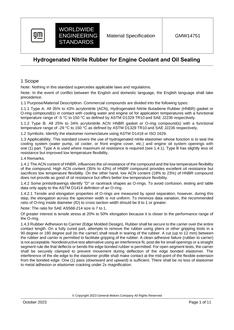
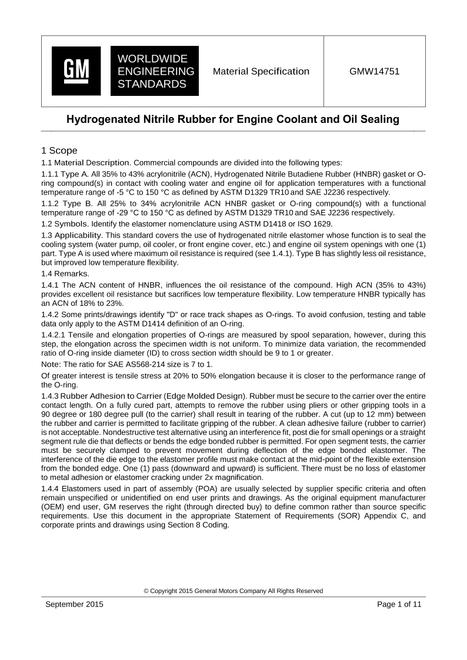
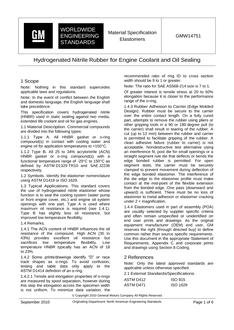
This specification covers hydrogenated nitrile (HNBR) used in static sealing against two media, extended life coolant and oil for gas engines.
Material Description. Commercial compounds are divided into the following types:
Type A. All HNBR gasket or o-ring compound(s) in contact with cooling water and engine oil for application temperatures to +150°C.
Type B. All 25 to 34% acrylonitrile (ACN) HNBR gasket or o-ring compound(s) with a functional temperature range of -29°C to 150°C as defined by ASTM D1329 TR10 and SAE J2236 respectively.
Symbols. Identify the elastomer nomenclature using ASTM D1418 or ISO 1629.
Typical Applications. This standard covers the use of hydrogenated nitrile elastomer whose function is to seal the cooling system (water pump or front engine cover, etc.) and engine oil system openings with one part. Type A is used where maximum oil resistance is required (see 1.4.1). Type B has slightly less oil resistance, but improved low temperature flexibility.
Remarks.
The ACN content of HNBR influences the oil resistance of the compound. High ACN (35 to 43%) provides excellent oil resistance but sacrifices low temperature flexibility. Low temperature HNBR typically has an ACN of 18 to 23%.
Some prints/drawings identify "D" or race track shapes as o-rings. To avoid confusion, testing and table data only apply to the ASTM D1414 definition of an o-ring.
Tensile and elongation properties of o-rings are measured by spool separation, however during this step the elongation across the specimen width is not uniform. To minimize data variation, the recommended ratio of ring ID to cross section width should be 9 to 1 or greater.
Note: The ratio for SAE AS568-214 size is 7 to 1.
Of greater interest is tensile stress at 20 to 50% elongation because it is closer to the performance range of the o-ring.
Rubber Adhesion to Carrier (Edge Molded Design). Rubber must be secure to the carrier over the entire contact length. On a fully cured part, attempts to remove the rubber using pliers or other gripping tools in a 90 or 180 degree pull (to the carrier) shall result in tearing of the rubber. A cut (up to 12 mm) between the rubber and carrier is permitted to facilitate gripping of the rubber. A clean adhesive failure (rubber to carrier) is not acceptable. Nondestructive test alternative using an interference fit, post die for small openings or a straight segment rule die that deflects or bends the edge bonded rubber is permitted. For open segment tests, the carrier must be securely clamped to prevent movement during deflection of the edge bonded elastomer. The interference of the die edge to the elastomer profile must make contact at the mid-point of the flexible extension from the bonded edge. One pass (downward and upward) is sufficient. There must be no loss of elastomer to metal adhesion or elastomer cracking under 2 × magnification.
Elastomers used in part of assembly (POA) are usually selected by supplier specific criteria and often remain unspecified or unidentified on end user prints and drawings. As the original equipment manufacturer (OEM) end user, GM reserves the right (through directed buy) to define common rather than source specific requirements. Use this document in the appropriate Statement of Requirements, Appendix C and corporate prints and drawings using Section 8 Coding.
| Edition : | 1 |
| File Size : | 1 file , 130 KB |
| Number of Pages : | 6 |
| Published : | 09/01/2010 |