Name:
GMW GMW16225 PDF
Published Date:
03/01/2012
Status:
[ Revised ]
Publisher:
General Motors Worldwide
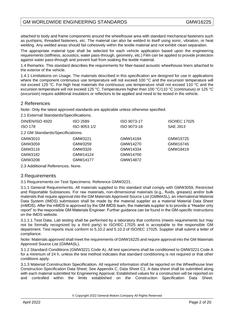
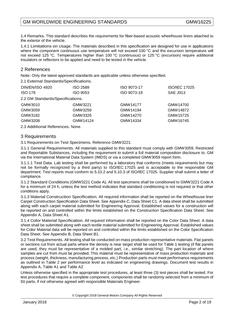
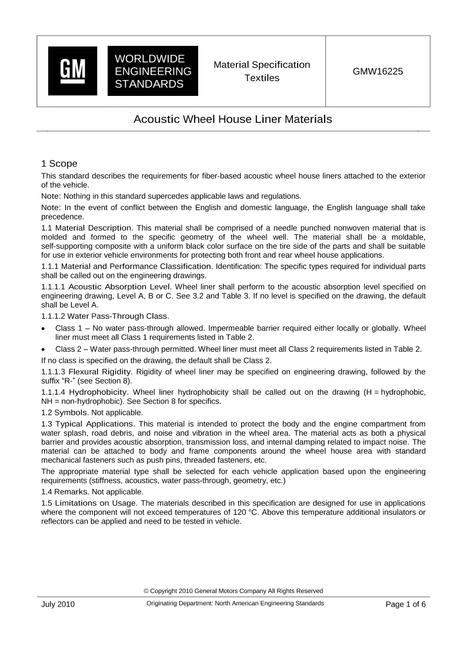
This standard describes the requirements for fiber-based acoustic wheel house liners attached to the exterior of the vehicle.
Material Description. This material shall be comprised of a needle punched non-woven material that is molded and formed to the specific geometry of the wheel well. The material shall be a moldable, selfsupporting composite with a uniform black color surface on the tire side of the parts and shall be suitable for use in exterior vehicle environments for protecting both front and rear wheel house applications.
Material and Performance Classification. Identification: The specific performance characteristics required for individual parts shall be called out on the engineering drawings. These properties are: weight per unit area, acoustic absorption level, water pass-through, flexural rigidity and hydrophobicity.
Weight per Unit Area.
• Type 1: 1000 ± 10% gsm (gram per square meter)
• Type 2: 1200 ± 10% gsm
• Type 3: 1400 ± 10% gsm
Acoustic Absorption Level. Wheel liner shall perform to the acoustic absorption level specified on engineering drawing, Level A, or B. See 3.2 and Table 3. If no level is specified on the drawing, the default shall be Level A.
Water Pass-Through Class.
• Class 1 – No water pass-through allowed. Impermeable barrier required either locally or globally. Wheel liner must meet all requirements listed in Tables 1 and 2 and all Class 1 requirements where noted. The fabric and film lamination must be tested.
• Class 2 – Minimal water pass-through permitted (full compression in a region). Wheel liner must meet all requirements listed in Tables 1 and 2 and all Class 2 requirements where noted.
• Class 3 - Some water pass-through permitted (regular compression in a region). Wheel liner must meet all requirements listed in Tables 1 and 2 and all Class 3 requirements where noted.
If no class is specified on the drawing, the default shall be Class 3.
Flexural Rigidity. Rigidity of wheel liner shall be specified on engineering drawing, followed by the suffix "R-" (see section 8 Coding).
Hydrophobicity. Wheel liner hydrophobicity shall be called out on the drawing (H = hydrophobic, NH = non-hydrophobic). See Section 8 Coding for specifics.
Symbols. Not applicable.
Typical Applications. This material is intended to protect the body and the engine compartment from water splash, road debris, and noise and vibration in the wheel area. The material acts as both a physical barrier and provides acoustic absorption, transmission loss, and internal damping related to impact noise. The material can be attached to body and frame components around the wheel house area with standard mechanical fasteners such as push pins, threaded fasteners, etc. The material can also be welded to itself using sonic, vibration or heat welding. Any welded areas should fail cohesively within the textile material and not exhibit clean separation.
The appropriate material type shall be selected for each vehicle application based upon the engineering requirements (stiffness, acoustics, water pass-through, geometry, etc.)
Remarks. Not applicable.
Limitations on Usage. The materials described in this specification are designed for use in applications where the component will not exceed temperatures of 120 °C. Above this temperature, additional insulators or reflectors can be applied and need to be tested in vehicle.
| Edition : | 3 |
| File Size : | 1 file , 340 KB |
| Number of Pages : | 14 |
| Published : | 03/01/2012 |