Name:
GMW GMW16285 PDF
Published Date:
08/01/2020
Status:
[ Active ]
Publisher:
General Motors Worldwide
Purpose.
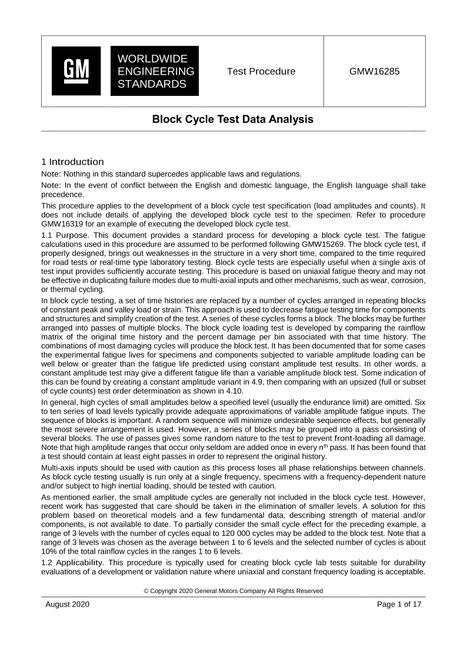
This document provides a standard process for developing a block cycle test. The fatigue calculations used in this procedure are assumed to be performed following GMW15269. The block cycle test, if properly designed, brings out weaknesses in the structure in a very short time, compared to the time required for road tests or real-time type laboratory testing. Block cycle tests are especially useful when a single axis of test input provides sufficiently accurate testing. This procedure is based on uniaxial fatigue theory and may not be effective in duplicating failure modes due to multi-axial inputs and other mechanisms, such as wear, corrosion, or thermal cycling.
In block cycle testing, a set of time histories are replaced by a number of cycles arranged in repeating blocks of constant peak and valley load or strain. This approach is used to decrease fatigue testing time for components and structures and simplify creation of the test. A series of these cycles forms a block. The blocks may be further arranged into passes of multiple blocks. The block cycle loading test is developed by comparing the rainflow matrix of the original time history and the percent damage per bin associated with that time history. The combinations of most damaging cycles will produce the block test. It has been documented that for some cases the experimental fatigue lives for specimens and components subjected to variable amplitude loading can be well below or greater than the fatigue life predicted using constant amplitude test results. In other words, a constant amplitude test may give a different fatigue life than a variable amplitude block test. Some indication of this can be found by creating a constant amplitude variant in 4.9, then comparing with an upsized (full or subset of cycle counts) test order determination as shown in 4.10.
In general, high cycles of small amplitudes below a specified level (usually the endurance limit) are omitted. Six to ten series of load levels typically provide adequate approximations of variable amplitude fatigue inputs. The sequence of blocks is important. A random sequence will minimize undesirable sequence effects, but generally the most severe arrangement is used. However, a series of blocks may be grouped into a pass consisting of several blocks. The use of passes gives some random nature to the test to prevent front-loading all damage. Note that high amplitude ranges that occur only seldom are added once in every nth pass. It has been found that a test should contain at least eight passes in order to represent the original history.
Multi-axis inputs should be used with caution as this process loses all phase relationships between channels. As block cycle testing usually is run only at a single frequency, specimens with a frequency-dependent nature and/or subject to high inertial loading, should be tested with caution.
As mentioned earlier, the small amplitude cycles are generally not included in the block cycle test. However, recent work has suggested that care should be taken in the elimination of smaller levels. A solution for this problem based on theoretical models and a few fundamental data, describing strength of material and/or components, is not available to date. To partially consider the small cycle effect for the preceding example, a range of 3 levels with the number of cycles equal to 120 000 cycles may be added to the block test. Note that a range of 3 levels was chosen as the average between 1 to 6 levels and the selected number of cycles is about 10% of the total rainflow cycles in the ranges 1 to 6 levels.
| Edition : | 3 |
| File Size : | 1 file , 980 KB |
| Number of Pages : | 17 |
| Published : | 08/01/2020 |