Name:
GMW GMW16600 PDF
Published Date:
05/01/2014
Status:
[ Revised ]
Publisher:
General Motors Worldwide
Introduction
Note: Nothing in this standard supercedes applicable laws and regulations.
Note: In the event of conflict between the English and domestic language, the English language shall take precedence.
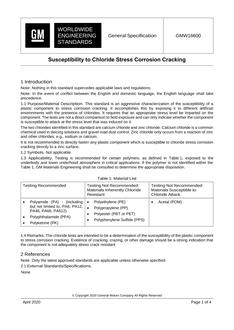
Purpose. This standard is an aggressive characterization of the susceptibility of a plastic component to Stress Corrosion Cracking. It accomplishes this by exposing it to different artificial environments with the presence of chlorides. It requires that an appropriate stress level be imparted on the component. The tests are not a direct comparison to field exposure and can only indicate whether the component is susceptible to attack at the stress level that was induced on it.
The two chlorides identified in this standard are calcium chloride and zinc chloride. Calcium Chloride is a common chemical used in de-icing solutions and gravel road dust control. Zinc Chloride only occurs from a reaction of zinc and other chlorides (e.g., sodium or calcium).
It is not recommended to directly fasten any plastic component which is susceptible to chloride stress corrosion cracking directly to a zinc surface.
Applicability. Testing is recommended for certain polymers (as defined in Table 1) exposed to the underbody and lower underhood atmosphere in critical applications. If the polymer is not identified within the table, GM Materials Engineering shall be consulted to determine the appropriate disposition.
The chloride tests are intended to be a determination of the susceptibility of the plastic component to Stress Corrosion Cracking. Evidence of cracking, crazing, or other damage should be a strong indication that the component is not adequately stress crack resistant.
| Edition : | 2 |
| File Size : | 1 file , 150 KB |
| Number of Pages : | 4 |
| Published : | 05/01/2014 |