Name:
GMW GMW3179 PDF
Published Date:
07/01/2007
Status:
[ Revised ]
Publisher:
General Motors Worldwide
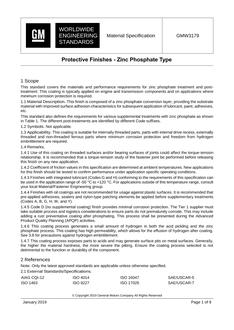
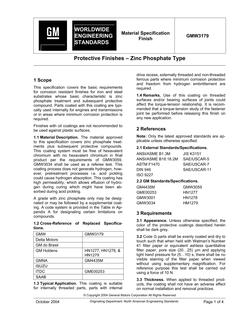
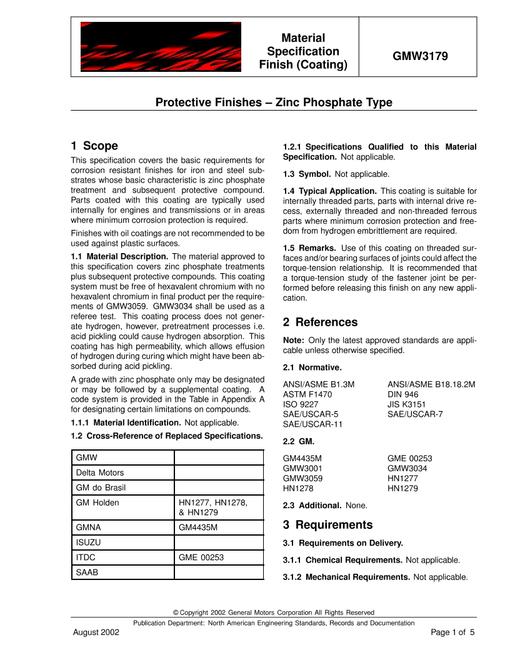
This standard covers the basic requirements for corrosion resistant finishes for iron and steel substrates whose basic characteristic is zinc phosphate treatment and subsequent protective compound. Parts coated with this coating are typically used internally for engines and transmissions or in areas where minimum corrosion protection is required. (e.g. low visible areas in the passenger compartment) Finishes with oil coatings are not recommended for usage against plastic surfaces. It is recommended that preapplied adhesives, sealers and nylon-type patching elements be applied before supplementary treatments. (code A, B, G, H, W, & Y.)
Material Description. The material approved to this specification covers zinc phosphate treatments plus subsequent protective compounds. This coating system must be free of hexavalent chromium with no hexavalent chromium in final product per the requirements of GMW3059. GMW3034 shall be used as a referee test. This coating process does not generate hydrogen, however, pretreatment processes i.e. acid pickling could cause hydrogen absorption. This coating has high permeability, which allows effusion of hydrogen during curing which might have been absorbed during acid pickling. This finish could be zinc phosphate only or different supplemental treatments with zinc phosphate as shown in Table 2 as different codes of this specification.
Typical Applications. This coating is suitable for internally threaded parts, parts with internal drive recess, externally threaded and non-threaded ferrous parts where minimum corrosion protection and freedom from hydrogen embrittlement are required.
Remarks. Use of this coating on threaded surfaces and/or bearing surfaces of joints could affect the torque-tension relationship. It is recommended that a torque-tension study of the fastener joint be performed before releasing this finish on any new application.
Coefficient of friction/torque tension values in this specification are determined at ambient temperatures. New applications for this finish should be tested to confirm performance under application specific, operating conditions.
Finishes with integrated lubricant (Code G & H) conforming to the requirements of this specification can be used in the application range of -50 to +120°C. For applications outside of this temperature range consult your local Material/Fastener Engineering group.
| Edition : | 5 |
| File Size : | 1 file , 140 KB |
| Number of Pages : | 4 |
| Published : | 07/01/2007 |