HOLDEN HN 2307 PDF

HOLDEN HN 2307 PDF

Name:
HOLDEN HN 2307 PDF

Published Date:
07/01/1998

Status:
[ Revised ]

Description:

Thermoplastic Polyurethane

Publisher:
Holden Limited

Document status:
Active

Format:
Electronic (PDF)

Delivery time:
10 minutes

Delivery time (for Russian version):
200 business days

SKU:

Choose Document Language:
$23.4
Need Help?

1. SCOPE

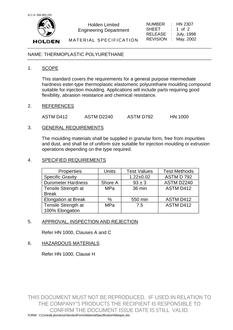
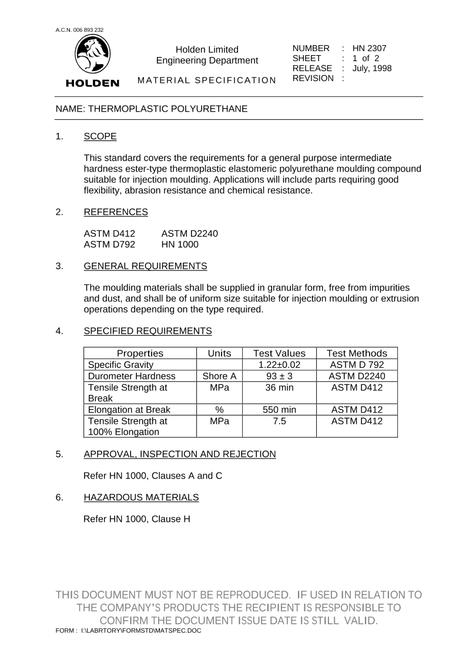
This standard covers the requirements for a general purpose intermediate hardness ester-type thermoplastic elastomeric polyurethane moulding compound suitable for injection moulding. Applications will include parts requiring good flexibility, abrasion resistance and chemical resistance.


Edition : 98
File Size : 1 file , 27 KB
Number of Pages : 2
Published : 07/01/1998

History

HOLDEN HN2307
Published Date: 09/01/2012
Thermoplastic Polyurethane
HOLDEN HN 2307
Published Date: 05/01/2002
Thermoplastic Polyurethane
$23.4
HOLDEN HN 2307
Published Date: 07/01/1998
Thermoplastic Polyurethane
$23.4

Related products

HOLDEN HN 1693
Published Date: 06/01/2008
PRIMER FOR EXTERIOR PLASTIC PARTS - PERFORMANCE REQUIREMENTS
HOLDEN HN1433
Published Date: 11/01/2012
Polypropylene - Glass Reinforced
HOLDEN HN 1218
Published Date: 11/01/2002
Thread - Sewing
$23.4

Best-Selling Products

NS-ISO/IEC 10149:1989
Published Date: 06/01/1989
Information technology — Data interchange on read-only 120 mm optical data disks (CD-ROM)
NS-ISO/IEC 10646:2020/Amd 1:2023
Published Date: 08/04/2023
Information technology - Universal coded character set (UCS) - Amendment 1: CJK Unified Ideographs Extension H, Vithkuqi, Old Uyghur, Cypro-Minoan, and other characters
NS-ISO/IEC 10646:2020
Published Date: 01/29/2021
Information technology - Universal coded character set (UCS)
NS-ISO/IEC 12207:1995
Published Date: 05/08/2001
Information technology — Software life cycle processes
NS-ISO/IEC 12207:2008
Published Date: 06/01/2010
Systems and software engineering — Software life cycle processes
NS-ISO/IEC 13250-2:2006
Published Date: 01/10/2008
Information technology - Topic Maps - Part 2: Data model