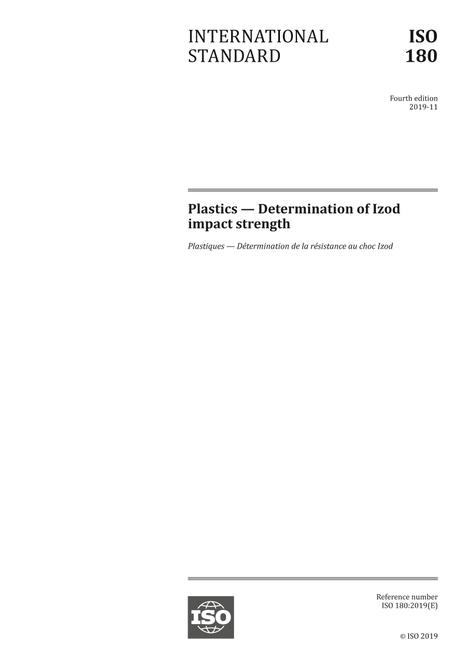
Name:
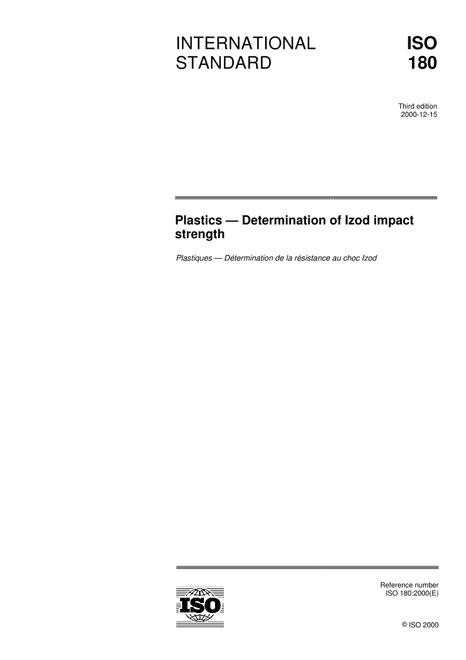
ISO 180:2000 PDF
Published Date:
12/15/2000
Status:
Active
This International Standard specifies a method for determining the Izod impact strength of plastics under defined conditions. A number of different types of specimen and test configurations are defined. Different test parameters are specified according to the type of material, the type of test specimen and the type of notch.
The method is used to investigate the behaviour of specified types of specimen under the impact conditions defined and for estimating the brittleness or toughness of specimens within the limitations inherent in the test conditions.
The method is suitable for use with the following range of materials:
The method is not normally suitable for use with rigid cellular materials and sandwich structures containing cellular material. Also, notched specimens are not normally used for long-fibre-reinforced composites or thermotropic liquid-crystal polymers.
The method is suited to the use of specimens which may be either moulded to the chosen dimensions, machined from the central portion of a standard multipurpose test specimen (see ISO 3167) or machined from finished or semifinished products such as mouldings, laminates and extruded or cast sheet.
The method specifies preferred dimensions for the test specimen. Tests which are carried out on specimens of different dimensions or with different notches, or specimens which are prepared under different conditions, may produce results which are not comparable. Other factors, such as the energy capacity of the apparatus, its impact velocity and the conditioning of the specimens can also influence the results. Consequently, when comparative data are required, these factors must be carefully controlled and recorded.
The method should not be used as a source of data for design calculations. Information on the typical behaviour of a material can be obtained, however, by testing at different temperatures, by varying the notch radius and/or the thickness and by testing specimens prepared under different conditions.
| File Size : | 1 file , 110 KB |
| Note : | This product is unavailable in Ukraine, Russia, Belarus |
| Number of Pages : | 10 |
| Published : | 12/15/2000 |
| Same As : | ISO 180:2000 |