Name:
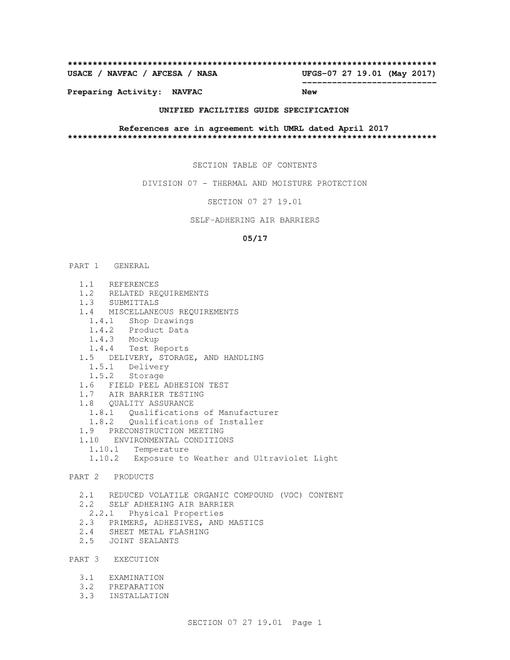
NAVY UFGS-07 27 19.01 PDF
Published Date:
05/01/2017
Status:
[ Revised ]
Publisher:
Naval Sea Systems Command
NOTE:
This guide specification covers the requirements for self-adhering air barrier, for use inside exterior wall cavities. This air barrier will serve as the primary component of the air barrier system and, depending on the system specified, may also serve as a vapor retarder. The designer must determine whether a vapor permeable or a vapor retarding system is appropriate for the project. The designer must also verify the appropriate location within the wall assembly by using the tools described in UFC 3-101-01 Architecture, Section "Vapor Retarders".
Compatibility with other materials and components are critical to the success of the air barrier. Coordinate with other building enclosure components (such as wall assemblies, doors, windows) to ensure a complete barrier system that adheres to performance requirements, primarily air leakage. Coordinate with materials that will penetrate the barrier such as flashing, embed items, and ties for brick veneer.
Use this section in conjunction with Section 07 27 10.00 10, BUILDING AIR BARRIER SYSTEM and Section 07 05 23 PRESSURE TESTING AN AIR BARRIER SYSTEM FOR AIR TIGHTNESS and coordinate requirements across these sections.
Performance requirements for products herein must contribute to the sustainable goals of the project, including but not limited to Energy Policy Act of 2005 (EPACT 2005), Energy Independence and Security Act of 2007 (EISA 2007), Executive Order (EO) 13423, Executive Order (EO) 13514, UFC 1-200-02 High Performance and Sustainable Building Requirements, UFGS Section 01 33 29 SUSTAINABILITY REPORTING, and other energy and water conservation requirements applicable to the project.
Specify self-adhering air barriers where the type of construction favors its economical use and where application would be less difficult than other air barrier applications. This product is susceptible to UV degradation, therefore specify product limit for full exposure in accordance with anticipated construction durations and include requirements for replacement if durations exceed exposed product life.
IBC 2015 introduces a change to the location within wall cavities of class I, II and III vapor retarders depending on their climate zone to avoid condensation within wall assemblies. See IBC Section 1405.3, and the new International Energy Conservation Code (IECC) 2015 referenced by this section of the IBC, coordinate dewpoint with mechanical design, and specify type and location within the cavity accordingly.
| Edition : | 17 |
| File Size : | 1 file , 43 KB |
| Number of Pages : | 15 |
| Published : | 05/01/2017 |


