Name:
BO-2367 -- Interindividual Differences in Ambient Temperatures Preferred PDF
Published Date:
1975
Status:
Active
Publisher:
ASHRAE
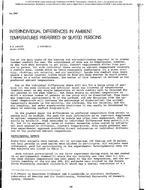
One of the main tasks of the heating and air-conditioning engineer is to create thermal comfort for man. The achievement of this aim is complicated, however, by the fact that everyone is not alike. Comfort requirements differ from person to person. For each individual there exists an ambient temperature interva~ a comfort zone, inside which he feels reasonably comfortable (at a given activity, clothing, air velocity, and air humidity). Inside his comfort zone there exists a narrow interval inside which he does not know whether he would prefer a warmer or a cooler environment. The center of this interval is defined as his preferred ambient temperature.
Due to the individual differences there will not for ·a large group of persons (at the same clothing and activity) exist any interval of temperatures (comfort ~one) or any single temperature at which comfort will be obtained for all persons at the same time(l). But there exists an optimal temperature at which a minimum number of.persons in the group will be dissatisfied •. This minimum comprises approximately·S% of the persons, and any deviation from the optimal temperature will increase the percentage of dissatisfied. The optimal temperature depends on the activity, the clothing, the air velocity, and the air humidity, and under steady-state conditions it can easily be determined by means of existing comfort diagrams(l,2)
In the present paper the differences in preferred temperature from person to person will be studied. The need for such information as an important supplement to optimal temperatures predicted by models has often been emphasized, most recently by Rohles(3). Some knowledge on individual differences does exist(l,3,4, 5), but it is expressed in terms of thermal sensation votes casted by subjects who were exposed to different, constant temperatures. This study presents another experimental approach providing direct information on individual differences of the preferred ambient temperature.
| File Size : | 1 file , 750 KB |
| Note : | This product is unavailable in Russia, Belarus |
| Number of Pages : | 8 |
| Product Code(s) : | D-BO-2367 |
| Published : | 1975 |