Name:
CH-18-C066 -- Simulation Study of Performance of Active Ceilings with Phase Change Material in Office Buildings under Extreme Climate Conditions PDF
Published Date:
2018
Status:
Active
Publisher:
ASHRAE
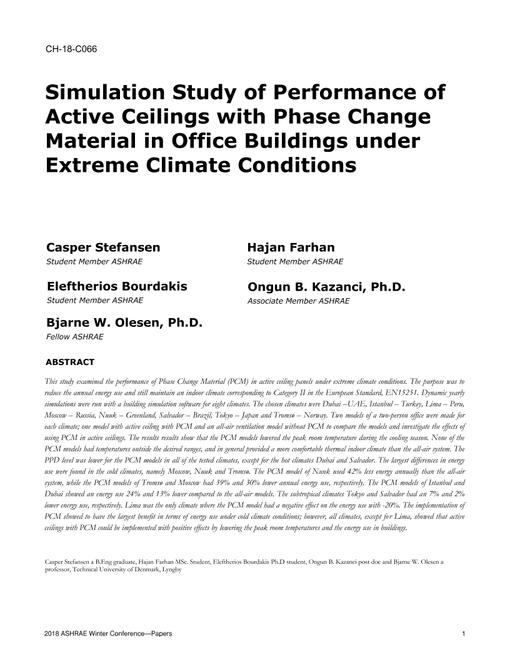
This study examined the performance of Phase Change Material (PCM) in active ceiling panels under extreme climate conditions. The purpose was to reduce the annual energy use and still maintain an indoor climate corresponding to Category II in the European Standard, EN15251. Dynamic yearly simulations were run with a building simulation software for eight climates. The chosen climates were Dubai –UAE, Istanbul - Turkey, Lima - Peru, Moscow - Russia, Nuuk - Greenland, Salvador - Brazil, Tokyo - Japan and Tromsø - Norway. Two models of a two-person office were made for each climate; one model with active ceiling with PCM and an all-air ventilation model without PCM to compare the models and investigate the effects of using PCM in active ceilings. The results results show that the PCM models lowered the peak room temperature during the cooling season. None of the PCM models had temperatures outside the desired ranges, and in general provided a more comfortable thermal indoor climate than the all-air system. The PPD level was lower for the PCM models in all of the tested climates, except for the hot climates Dubai and Salvador.
The largest differences in energy use were found in the cold climates, namely Moscow, Nuuk and Tromsø. The PCM model of Nuuk used 42% less energy annually than the all-air system, while the PCM models of Tromsø and Moscow had 39% and 30% lower annual energy use, respectively. The PCM models of Istanbul and Dubai showed an energy use 24% and 13% lower compared to the all-air models. The subtropical climates Tokyo and Salvador had an 7% and 2% lower energy use, respectively. Lima was the only climate where the PCM model had a negative effect on the energy use with -20%. The implementation of PCM showed to have the largest benefit in terms of energy use under cold climate conditions; however, all climates, except for Lima, showed that active ceilings with PCM could be implemented with positive effects by lowering the peak room temperatures and the energy use in buildings.
| File Size : | 1 file , 520 KB |
| Note : | This product is unavailable in Russia, Belarus |
| Number of Pages : | 8 |
| Product Code(s) : | D-CH-18-C066 |
| Published : | 2018 |
| Units of Measure : | Dual |