Name:
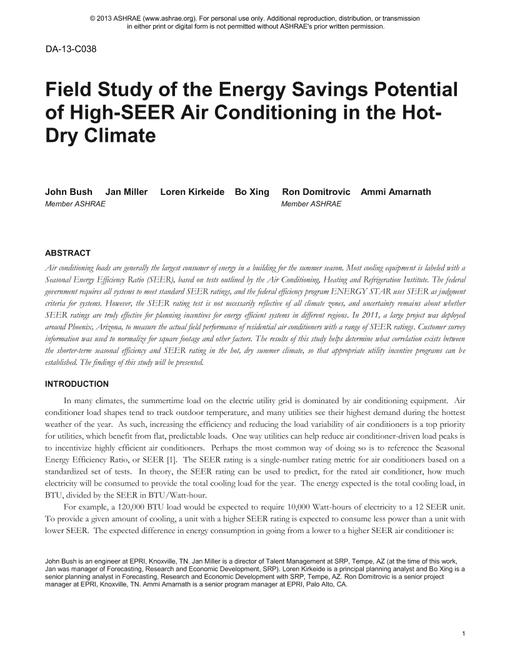
DA-13-C038 -- Field Study of the Energy Savings Potential of High-SEER Air Conditioning in the Hot-Dry Climate PDF
Published Date:
2013
Status:
Active
Publisher:
ASHRAE
Air conditioning loads are generally the largest consumer of energy in a building for the summer season. Most cooling equipment is labeled with a Seasonal Energy Efficiency Ratio (SEER), based on tests outlined by the Air Conditioning, Heating and Refrigeration Institute. The federal government requires all systems to meet standard SEER ratings, and the federal efficiency program ENERGY STAR uses SEER as judgment criteria for systems. However, the SEER rating test is not necessarily reflective of all climate zones, and uncertainty remains about whether SEER ratings are truly effective for planning incentives for energy efficient systems in different regions. In 2011, a large project was deployed around Phoenix, Arizona, to measure the actual field performance of residential air conditioners with a range of SEER ratings. Customer survey information was used to normalize for square footage and other factors. The results of this study helps determine what correlation exists between the shorter-term seasonal efficiency and SEER rating in the hot, dry summer climate, so that appropriate utility incentive programs can be established. The findings of this study will be presented.
| File Size : | 1 file , 750 KB |
| Note : | This product is unavailable in Russia, Belarus |
| Number of Pages : | 9 |
| Product Code(s) : | D-DA-13-C038 |
| Published : | 2013 |