Name:
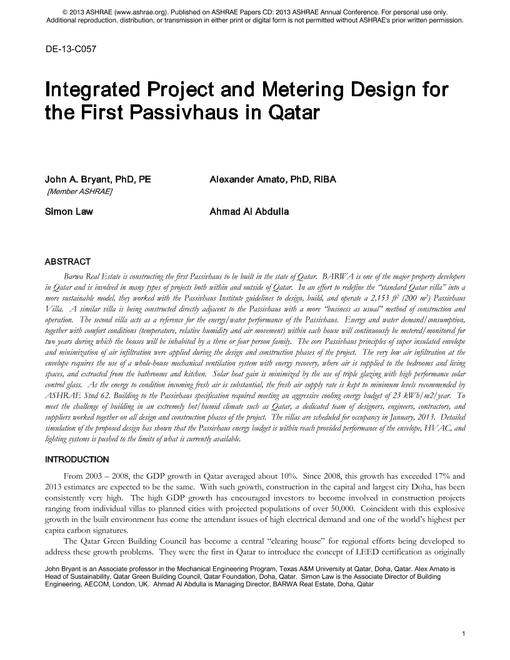
DE-13-C057 -- Integrated Project and Metering Design for the First Passivhaus in Qatar PDF
Published Date:
2013
Status:
Active
Publisher:
ASHRAE
Barwa Real Estate is constructing the first Passivhaus to be built in the state of Qatar. BARWA is one of the major property developers in Qatar and is involved in many types of projects both within and outside of Qatar. In an effort to redefine the "standard Qatar villa" into a more sustainable model, they worked with the Passivhaus Institute guidelines to design, build, and operate a 2,153 ft2 (200 m2) Passivhaus Villa. A similar villa is being constructed directly adjacent to the Passivhaus with a more "business as usual" method of construction and operation. The second villa acts as a reference for the energy/water performance of the Passivhaus. Energy and water demand/consumption, together with comfort conditions (temperature, relative humidity and air movement) within each house will continuously be metered/monitored for two years during which the houses will be inhabited by a three or four person family. The core Passivhaus principles of super insulated envelope and minimization of air infiltration were applied during the design and construction phases of the project. The very low air infiltration at the envelope requires the use of a whole-house mechanical ventilation system with energy recovery, where air is supplied to the bedrooms and living spaces, and extracted from the bathrooms and kitchen. Solar heat gain is minimized by the use of triple glazing with high performance solar control glass. As the energy to condition incoming fresh air is substantial, the fresh air supply rate is kept to minimum levels recommended by ASHRAE Stnd 62. Building to the Passivhaus specification required meeting an aggressive cooling energy budget of 23 kWh/m2/year. To meet the challenge of building in an extremely hot/humid climate such as Qatar, a dedicated team of designers, engineers, contractors, and suppliers worked together on all design and construction phases of the project. The villas are scheduled for occupancy in January, 2013. Detailed simulation of the proposed design has shown that the Passivhaus energy budget is within reach provided performance of the envelope, HVAC, and lighting systems is pushed to the limits of what is currently available.
| File Size : | 1 file , 1 MB |
| Note : | This product is unavailable in Russia, Belarus |
| Number of Pages : | 8 |
| Product Code(s) : | D-DE-13-C057 |
| Published : | 2013 |