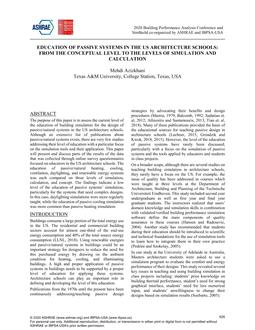
Solid desiccant dehumidification systems are an alternative to dehumidification systems through condensation. They use solid desiccant materials to adsorb the moisture in the process air for space cooling. There are two configurations of the solid desiccant dehumidification system: desiccant wheels and desiccant coated heat exchangers (DCHE). Previous studies focused on the effect on dehumidification performance using different desiccant materials on the DCHE. However, the performance of dehumidification remains to be quantified because the geometrical and operational conditions of the DCHE also play an essential role in its dehumidification performance for a given desiccant material. Therefore, it is important to evaluate their effects on dehumidification performance through modeling to assist in component design and operation. This paper provides the details of a one-dimensional heat and mass transfer model developed for this purpose. The model uses an implicit finite difference scheme to solve the governing equations, which represent the heat and mass balances in the control volume. The heat balances are evaluated for the airflow, water flow, tube, desiccant, and fin. The fin and solid desiccant are considered as having the same temperature. The mass balances are evaluated for the airside and the solid desiccant material. The outlet humidity results for dehumidification and regeneration showed a deviation lower than 15% from the experiment for most of the time. Still, the outlet temperature showed more difference, with results outside the 15% deviation range. The model temperature results also showed a faster change than the experiment. The model developed can be used to assist in the optimization of component design and operation for the best dehumidification performance.
| File Size : | 1
file
, 3.2 MB |
| Note : | This product is unavailable in Russia, Belarus |
| Number of Pages : | 10 |
| Product Code(s) : | D-BSC20-C040 |
| Published : | 2020 |
| Units of Measure : | Dual |