Name:
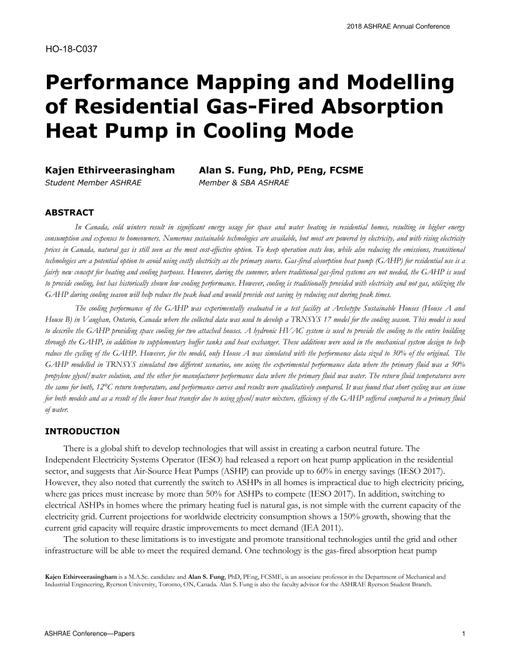
HO-18-C037 -- Performance Mapping and Modelling of Residential Gas-Fired Absorption Heat Pump in Cooling Mode PDF
Published Date:
2018
Status:
Active
Publisher:
ASHRAE
In Canada, cold winters result in significant energy usage for space and water heating in residential homes, resulting in higher energy consumption and expenses to homeowners. Numerous sustainable technologies are available, but most are powered by electricity, and with rising electricity prices in Canada, natural gas is still seen as the most cost-effective option. To keep operation costs low, while also reducing the emissions, transitional technologies are a potential option to avoid using costly electricity as the primary source. Gas-fired absorption heat pump (GAHP) for residential use is a fairly new concept for heating and cooling purposes. However, during the summer, where traditional gas-fired systems are not needed, the GAHP is used to provide cooling, but has historically shown low cooling performance. However, cooling is traditionally provided with electricity and not gas, utilizing the GAHP during cooling season will help reduce the peak load and would provide cost saving by reducing cost during peak times.
The cooling performance of the GAHP was experimentally evaluated in a test facility at Archetype Sustainable Houses (House A and House B) in Vaughan, Ontario, Canada where the collected data was used to develop a TRNSYS 17 model for the cooling season. This model is used to describe the GAHP providing space cooling for two attached houses. A hydronic HVAC system is used to provide the cooling to the entire building through the GAHP, in addition to supplementary buffer tanks and heat exchanger. These additions were used in the mechanical system design to help reduce the cycling of the GAHP. However, for the model, only House A was simulated with the performance data sized to 30% of the original. The GAHP modelled in TRNSYS simulated two different scenarios, one using the experimental performance data where the primary fluid was a 50% propylene glycol/water solution, and the other for manufacturer performance data where the primary fluid was water. The return fluid temperatures were the same for both, 12°C return temperature, and performance curves and results were qualitatively compared. It was found that short cycling was an issue for both models and as a result of the lower heat transfer due to using glycol/water mixture, efficiency of the GAHP suffered compared to a primary fluid of water.
| File Size : | 1 file , 1.2 MB |
| Note : | This product is unavailable in Russia, Belarus |
| Number of Pages : | 8 |
| Product Code(s) : | D-HO-18-C037 |
| Published : | 2018 |
| Units of Measure : | Dual |