Name:
HO-18-C059 -- Using Bluetooth Based Occupancy Estimation for HVAC Set-back to Reduce Energy Consumption in Buildings PDF
Published Date:
2018
Status:
Active
Publisher:
ASHRAE
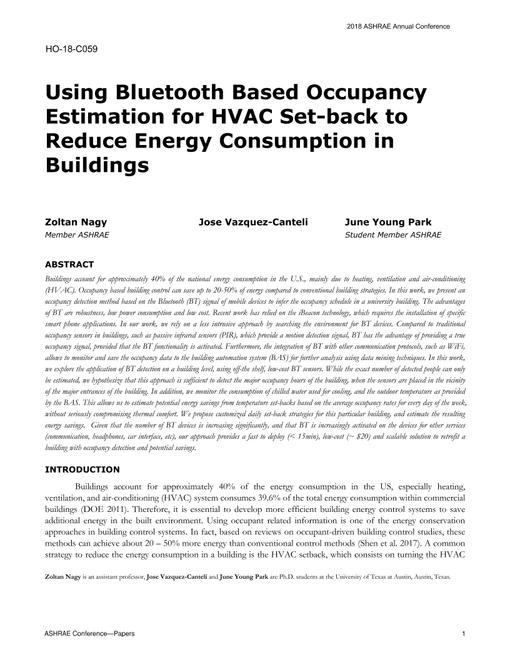
Buildings account for approximately 40% of the national energy consumption in the U.S., mainly due to heating, ventilation and air-conditioning(HVAC). Occupancy based building control can save up to 20-50% of energy compared to conventional building strategies. In this work, we present anoccupancy detection method based on the Bluetooth (BT) signal of mobile devices to infer the occupancy schedule in a university building. The advantagesof BT are robustness, low power consumption and low cost. Recent work has relied on the iBeacon technology, which requires the installation of specificsmart phone applications. In our work, we rely on a less intrusive approach by searching the environment for BT devices. Compared to traditionaloccupancy sensors in buildings, such as passive infrared sensors (PIR), which provide a motion detection signal, BT has the advantage of providing a trueoccupancy signal, provided that the BT functionality is activated. Furthermore, the integration of BT with other communication protocols, such as WiFi,allows to monitor and save the occupancy data to the building automation system (BAS) for further analysis using data mining techniques. In this work,we explore the application of BT detection on a building level, using off-the shelf, low-cost BT sensors. While the exact number of detected people can onlybe estimated, we hypothesize that this approach is sufficient to detect the major occupancy hours of the building, when the sensors are placed in the vicinityof the major entrances of the building. In addition, we monitor the consumption of chilled water used for cooling, and the outdoor temperature as providedby the BAS. This allows us to estimate potential energy savings from temperature set-backs based on the average occupancy rates for every day of the week,without seriously compromising thermal comfort. We propose customized daily set-back strategies for this particular building, and estimate the resultingenergy savings. Given that the number of BT devices is increasing significantly, and that BT is increasingly activated on the devices for other services(communication, headphones, car interface, etc), our approach provides a fast to deploy (< 15min), low-cost (~ $20) and scalable solution to retrofit abuilding with occupancy detection and potential savings.
| File Size : | 1 file , 1.2 MB |
| Note : | This product is unavailable in Russia, Belarus |
| Number of Pages : | 8 |
| Product Code(s) : | D-HO-18-C059 |
| Published : | 2018 |
| Units of Measure : | Dual |