HVAC Design in Extreme Defensive Conditions: Temporary Refuges and Shelters PDF

HVAC Design in Extreme Defensive Conditions: Temporary Refuges and Shelters PDF

Name:
HVAC Design in Extreme Defensive Conditions: Temporary Refuges and Shelters PDF

Published Date:
2020

Status:
Active

Description:

Publisher:
ASHRAE

Document status:
Active

Format:
Electronic (PDF)

Delivery time:
10 minutes

Delivery time (for Russian version):
200 business days

SKU:

Choose Document Language:
$4.8
Need Help?
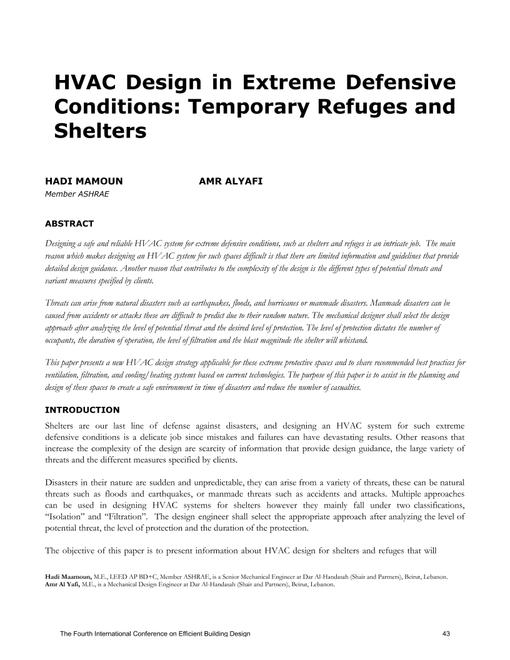
Designing a safe and reliable HVAC system for extreme defensive conditions, such as shelters and refuges is an intricate job. The main reason which makes designing an HVAC system for such spaces difficult is that there are limited information and guidelines that provide detailed design guidance. Another reason that contributes to the complexity of the design is the different types of potential threats and variant measures specified by clients. Threats can arise from natural disasters such as earthquakes, floods, and hurricanes or manmade disasters. Manmade disasters can be caused from accidents or attacks these are difficult to predict due to their random nature. The mechanical designer shall select the design approach after analyzing the level of potential threat and the desired level of protection. The level of protection dictates the number of occupants, the duration of operation, the level of filtration and the blast magnitude the shelter will whistand. This paper presents a new HVAC design strategy applicable for these extreme protective spaces and to share recommended best practices for ventilation, filtration, and cooling/heating systems based on current technologies. The purpose of this paper is to assist in the planning and design of these spaces to create a safe environment in time of disasters and reduce the number of casualties.
File Size : 1 file , 1.8 MB
Note : This product is unavailable in Russia, Belarus
Number of Pages : 8
Product Code(s) : D-ICEB20-06
Published : 2020
Units of Measure : Dual

History


Related products


Best-Selling Products

CAN/CSA-CEI/IEC 1000-1-1-97 (R2023)
Published Date: 01/18/2000
Electromagnetic Compatibility (EMC) - Part 1: General - Section 1: Application and Interpretation of Fundamental Definitions and Terms (Adopted CEI/IEC 1000-1-1:1992)
$37.8
CAN/CSA-CEI/IEC 1000-2-1-97 (R2023)
Published Date: 01/18/2000
Electromagnetic Compatibility (EMC) - Part 2: Environment - Section 1: Description of the Environment - Electromagnetic Environment for Low-Frequency Conducted Disturbances and Signalling in Public Power Supply Systems (Adopted CEI/IEC 1000- 2-1:1990) / Compatibilite electromagnetique (CEM) - Partie
$36.3
CAN/CSA-CEI/IEC 1160-96 (R2001)
Published Date: 05/03/2000
Formal Design Review (Adopted CEI/IEC 1160:1992) / Revue de conception formalisee (norme CEI/IEC 1160:1992 adoptee)
$31.5
CAN/CSA-CEI/IEC 1258-98 (R2002)
Published Date: 02/25/2000
Guidelines for the Development and Use of Medical Electrical Equipment Educational Materials (Adopted CEI/IEC 1258:1994, first edition) / Guide pour le developpement et l'utilisation des supports educatifs relatifs aux appareils electromedicaux (norme CEI/IEC 1258:1994 adoptee, premiere edition) **
CAN/CSA-CEI/IEC 1288-1-98 (R2012)
Published Date: 02/16/2000
Cardiac Defibrillators - Cardiac Defibrillators-Monitors - Part 1: Operation (Adopted CEI/IEC 1288-1:1993, first edition) / Defibrillateurs cardiaques - Moniteurs-defibrillateurs cardiaques - Partie 1: Fonctionnement (norme CEI/IEC 1288-1:1993 adoptee, premiere edition)
CAN/CSA-CEI/IEC 1288-2-98 (R2012)
Published Date: 02/16/2000
Cardiac Defibrillators - Cardiac Defibrillators-Monitors - Part 2: Maintenance (Adopted CEI/IEC 1288-2:1993, first edition) / Defibrillateurs cardiaques - Moniteurs-defibrillateurs cardiaques - Partie 2: Maintenance (norme CEI/IEC 1288-2:1993 adoptee, premiere edition)