Name:
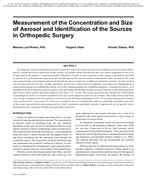
Measurement of the Concentration and Size of Aerosol and Identification of the Sources in Orthopedic Surgery PDF
Published Date:
2011
Status:
Active
Publisher:
ASHRAE
In orthopedic surgery, usually the generation of particles tends to be intense because some equipment used can produce disturbances, resuspend particles deposited on the surfaces or produce smoke and aerosols that can remain suspended in the air or be deposited on the surfaces, contaminating them. Therefore, in order to assess exposure to these agents to the patient and other occupants, it is of fundamental importance the identification of the sources of these contaminants. Thus, the goal of this work was to measure the concentration and size and identify the sources of particles in different orthopedic surgeries. For this, particle concentration and size (0.3 µm - 10 µm), and indoor activity were collected in an orthopedic operating room. Manipulation of surgical linen and gowns, handling the patient, use of electrosurgical apparatus, handling equipment, cleaning the room etc, were identified as the most important particle sources in the operating room having varying associated exposure to the health of patients and workers. Most of these particles produced were above 1.0 - 3.0 µm. This means that practically all particles of biological or pathological interest can remain suspended in air and can be dispersed widely by air currents. The results showed that there was a strong correlation between all particle sizes above 1 µm. Particles with diameter of 0.3 - 0.5 µm only had a good correlation with particles of 0.5 -1.0 µm and 1.0 -3.0 µm in two surgeries. It was concluded that within an orthopedic operating room, most of the events responsible for generating particle is brief, intermittent and highly variable, requiring the use of specific instrumentation for the continuous identification and characterization.
| File Size : | 1 file , 500 KB |
| Note : | This product is unavailable in Russia, Belarus |
| Number of Pages : | 9 |
| Product Code(s) : | D-IAQ2010-C154-10 |
| Published : | 2011 |