Name:
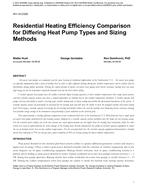
NY-14-C029 -- Residential Heating Efficiency Comparison for Differing Heat Pump Types and Sizing Methods PDF
Published Date:
2014
Status:
Active
Publisher:
ASHRAE
Air-source heat pumps are commonly used for space heating in residential applications in the Southeastern U.S. Air-source heat pumps are typically implemented with a form of backup heat in order to offer sufficient heating during low outdoor temperatures and to combat cold air distribution during defrost operation. During the coldest periods of winter, air-source heat pumps with electric resistance backup heat can cause high energy use for the homeowner and peak demand issues for the local electric utility.
Variable capacity heat pumps have the ability to provide higher heating capacities at lower outdoor temperatures than single speed systems, and thus variable capacity systems may have a reduced dependence on backup heat in low outdoor temperature situations. Variable capacity heat pumps also have flexibility to match a heating load, sensible cooling load, or latent cooling load within the operational boundaries of the system. A variable capacity system can potentially be oversized for the heating load and still have the ability to meet the designed sensible and latent cooling load. Over-sizing a variable capacity heat pump for the heating load further reduces the need for backup heat. Reducing electric resistance backup heat provides energy savings to the homeowner and potentially a peak reduction on the electrical grid.
This report provides a heating efficiency comparison of two residential field sites in the Southeastern U.S. Both field sites had a single speed air-source heat pump monitored for two heating seasons, followed by a variable capacity system retrofitted into the homes for one heating season. For the variable speed retrofit, one of the two systems was sized approximately one ton higher than the heating load calculation, while the other system was sized at approximately the same tonnage as the heating load. Results demonstrate the ability of variable capacity equipment to reduce the use of backup electric heat in low outdoor temperatures. For the oversized field site, the variable capacity equipment demonstrated a backup electric heat reduction of 79% on average and a power reduction of 56% on average during the lowest outdoor temperatures.
| File Size : | 1 file , 2.4 MB |
| Note : | This product is unavailable in Russia, Belarus |
| Number of Pages : | 8 |
| Product Code(s) : | D-NY-14-C029 |
| Published : | 2014 |