Name:
NY-91-13-2 -- Optimum Design of Oblique Flow Headers PDF
Published Date:
1991
Status:
Active
Publisher:
ASHRAE
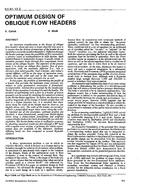
An important consideration in the design of oblique flow headers whose exit is larger than the inlet area is to ensure that the devices downstream of the header do not experience a severely maldistributed flow. Diffusion through the header passage raises the possibility of flow separation, a primary cause of maldistribution in such devices. Such maldistribution is undesirable because it usually results in excessive pressure drops through flow components down-stream of the oblique header. The objective of the present study is to design an oblique flow header, free of gross separation, with the maximum diffusion (i.e., exit to entrance area ratio) possible. Such a header, also called a curved diffuser, will be on the verge of separation everywhere along the solid wall and at the same time will provide the maximum static pressure rise as well. The problem of determining the profile of a header that provides the maximum static pressure rise subject to some geometrical constraints is formulated. Incompressible, laminar flow governed by the steady-state Navier-Stokes equations is assumed through the header. The problem of determining such a flow in a header of known geometry can be solved by obtaining the numerical solution to the Navier-Stokes equations. To deduce the direction and relative magnitude of the change in header profile that will lead to a higher pressure rise, it is assumed that shear stress along the walls of the header must be close to, but slightly above zero. The walls of the header are moved to achieve a prespecified target shear stress along the walls. By repeated use of this procedure, optimum profiles are obtained. A three-dimensional, steady-state Navier-Stokes solver using a finite-volume formulation and artificial compressibility method has been developed for use with this algorithm. The Navier-Stokes solver is verified for accuracy by obtaining numerical results for flow through a 90 degree bend with a square cross section, a geometry for which experimental data are available in the literature. Optimum diffusing bends are then computed at several Reynolds numbers.
KEYWORDS: optimum, designing, headers, fluid flow, pressure drop, geometry, diffusers, streamline flow, Reynolds numbers, algorithms, steady state, calculating.
| File Size : | 1 file , 1.3 MB |
| Note : | This product is unavailable in Russia, Belarus |
| Number of Pages : | 11 |
| Product Code(s) : | D-18605 |
| Published : | 1991 |