Name:
TA-23-C009 – Energy Savings with Destratification Fans in National Guard Facilities during Heating Season PDF
Published Date:
2023
Status:
Active
Publisher:
ASHRAE
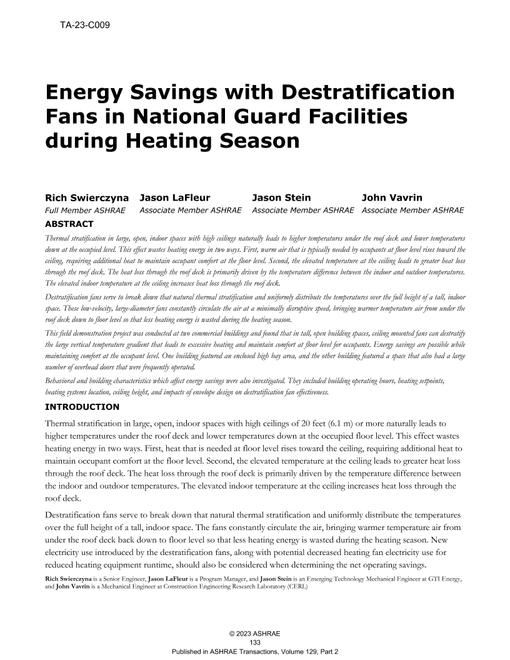
Thermal stratification in large, open, indoor spaces with high ceilings naturally leads to higher temperatures under the roof deck and lower temperatures down at the occupied level. This effect wastes heating energy in two ways. First, warm air that is typically needed by occupants at floor level rises toward the ceiling, requiring additional heat to maintain occupant comfort at the floor level. Second, the elevated temperature at the ceiling leads to greater heat loss through the roof deck. The heat loss through the roof deck is primarily driven by the temperature difference between the indoor and outdoor temperatures. The elevated indoor temperature at the ceiling increases heat loss through the roof deck. Destratification fans serve to break down that natural thermal stratification and uniformly distribute the temperatures over the full height of a tall, indoor space. These low-velocity, large-diameter fans constantly circulate the air at a minimally disruptive speed, bringing warmer temperature air from under the roof deck down to floor level so that less heating energy is wasted during the heating season. This field demonstration project was conducted at two commercial buildings and found that in tall, open building spaces, ceiling mounted fans can destratify the large vertical temperature gradient that leads to excessive heating and maintain comfort at floor level for occupants. Energy savings are possible while maintaining comfort at the occupant level. One building featured an enclosed high bay area, and the other building featured a space that also had a large number of overhead doors that were frequently operated. Behavioral and building characteristics which affect energy savings were also investigated. They included building operating hours, heating setpoints, heating systems location, ceiling height, and impacts of envelope design on destratification fan effectiveness.
| File Size : | 1 file , 2.1 MB |
| Note : | This product is unavailable in Russia, Belarus |
| Product Code(s) : | D-TA-23-C009 |
| Published : | 2023 |