TAPPI T274 PDF

TAPPI T274 PDF

Name:
TAPPI T274 PDF

Published Date:

Status:
Active

Description:

Laboratory Screening of Pulp (MasterScreen-type Instrument)

Publisher:
Technical Association of the Pulp and Paper Industry

Document status:
Active

Format:
Electronic (PDF)

Delivery time:
10 minutes

Delivery time (for Czech version):
200 business days

SKU:
tappi-t274_921232

Choose Document Language:
0
Need Help?
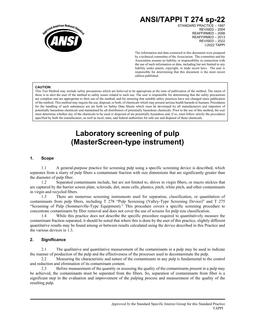
A general purpose practice for screening pulp using a specific screening device is described, which separates from a slurry of pulp fibers a contaminant fraction with size dimensions which are significantly greater than the diameter of a pulp fiber. Separated contaminants include, but are not limited to, shives in virgin fibers, or stickies and other contaminants in recycled fibers. There are numerous screening instruments used for separation, classification, or quantitation of contaminants from pulp fibers, or pulp fibers themselves on the basis of size using laboratory screening technology. These devices include the Valley, Von Alfthan, Somerville, Williamson, and Haindl - type screening devices. Useful methods based on the Valley, Von Alfthan, and Somerville - type devices were a part of the TAPPI Useful Methods procedures which are no longer published. In addition, T 233 Fiber length of pulp by classification describes use of both the Clark and Bauer-McNett - type pulp classifiers which separate pulp fibers into various length classifications by screening. This procedure covers a specific screening procedure to remove contaminants, and does not cover use of screens for pulp size classification. The specific device described in this practice is the MasterScreen - type instrument. While this Practice does not describe the specific procedure required to quantitatively measure the contaminant fraction separated, it should be noted that where this is done by the user of this practice, slightly different quantitative results may be found among or between results calculated using the device described in this Practice and the various devices in 1.3.

History

TAPPI T 274 sp-22
Published Date: 2022
Laboratory Screening of Pulp (MasterScreen-type Instrument)
14.70 €
TAPPI T 274 sp-13
Published Date: 2008
Laboratory Screening of Pulp (MasterScreen-type Instrument)
14.70 €
TAPPI T 274
Published Date: 04/01/2004
Laboratory Screening of Pulp (MasterScreen-type Instrument) Screening of Pulp (ille-Type Equ)
TAPPI T274
Published Date:
Laboratory Screening of Pulp (MasterScreen-type Instrument)

Related products

TAPPI T 429 cm-23
Published Date: 2023
Alpha-Cellulose in Paper
14.70 €
TAPPI T 435 om-22
Published Date: 2015
Hydrogen Ion Concentration (pH) of Paper Extracts (Hot Extraction Method)
14.70 €
TAPPI T 233 cm-15
Published Date: 2015
Fiber Length of Pulp by Classification
14.70 €
TAPPI T 230 om-23
Published Date: 2023
Viscosity of Pulp (Capillary Viscometer Method)
14.70 €

Best-Selling Products

SN-CEN/TS 1007-7:2006
Published Date: 09/27/2006
Advanced technical ceramics — Ceramic composites. Methods of test for reinforcements — Part 7: Determination of the distribution of tensile strength and of tensile strain to failure of filaments within a multifilament tow at high temperature
SN-CEN/TS 1046:2021
Published Date: 06/22/2021
Thermoplastics piping and ducting systems - Outside the building structures for gravity and pressurised systems - Trench installation
SN-CEN/TS 1071-10:2004
Published Date: 07/21/2004
Advanced technical ceramics — Methods of test for ceramic coatings — Part 10: Determination of coating thickness by cross sectioning
SN-CEN/TS 1071-11:2005
Published Date: 10/19/2005
Advanced technical ceramics — Methods of test for ceramic coatings — Part 11: Determination of internal stress by the Stoney formula
SN-CEN/TS 1071-8:2004
Published Date: 09/01/2004
Advanced technical ceramics — Methods of test for ceramic coatings — Part 8: Rockwell indentation test for evaluation of adhesion
SN-CEN/TS 1071-9:2004
Published Date: 02/11/2004
Advanced technical ceramics — Methods of test for ceramic coatings — Part 9: Determination of fracture strain