Name:
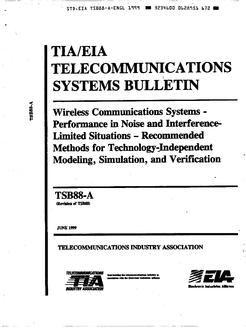
TIA TSB-88-B PDF
Published Date:
09/01/2004
Status:
[ Withdrawn ]
Publisher:
Telecommunications Industry Association
This bulletin gives guidance on the following areas:
• Establishment of standardized methodology for modeling and simulating narrowband/bandwidth efficient technologies operating in a post "Refarming" environment;
• Establishment of a standardized methodology for empirically confirming the performance of narrowband/bandwidth efficient systems operating in a post "Refarming" environment;
• Aggregating the modeling, simulation and empirical performance verification reports into a unified "Spectrum Management Tool Kit" which may be employed by frequency coordinators, systems engineers and system operators;
• Recommended databases that are available for improved results from modeling and simulation; and
• Providing current information for new and emerging bands such as the 700 MHz band.
The purpose of this document is to define and advance a scientifically sound standardized methodology for addressing technology compatibility. This document provides a formal structure and quantitative technical parameters from which automated design and spectrum management tools can be developed based on proposed configurations that may temporarily exist during a migration process or for longer term solutions for systems that have different technologies.
As wireless communications systems evolve, the complexity in determining compatibility between different types of modulation, different operational geographic areas, and application usage increases.
Spectrum managers, system designers and system maintainers have a common interest in utilizing the most accurate and repeatable modeling and simulation capabilities to determine likely wireless communication system performance. With increasing market competition, both in terms of modulation techniques offered and in the number of entities involved in wireless communications systems, a standardized approach and methodology is needed for the modeling and simulation of wireless communications system performance, considering both analog and digital practices in all frequency bands of interest.
In addition, subsequent to wireless communications system implementation, validity or acceptance testing is often an issue subject to much debate and uncertainty. Long after a system is in place and optimized, future interference dispute resolution demands application of a unified quantitative methodology for assessing system performance and interference.
This document also provides a standardized definition and methodology to a process for determining when various wireless communications configurations are compatible. The document contains performance recommendations for public safety and non-public safety type systems that should be used in the modeling and simulation of these systems. This document also satisfies the requirement for a standardized empirical measurement methodology that is useful for routine proof-of-performance and acceptance testing and in dispute resolution of interference cases that are likely to emerge in the future.
To provide this utility requires that specific manufacturers define various performance criteria for the different modulations and their specific implementations. Furthermore, sufficient reference information is provided so that software applications can be developed and employed to determine if the desired system performance can be realized.
Wireless system performance can be modeled and simulated with the effects of single or multiple potential distortion sources taken into account. These sources include:
• Co-channel users
• Off-channel users
• Internal noise sources
• External noise sources
• Equipment non-linearity
• Transmission path geometry
• Delay spread and differential signal phase
Predictions of system performance can then be based on the desired RF carrier versus the combined effects of single or multiple performance degrading sources. Performance is then based on a faded environment to more accurately simulate actual usage and considers both signal magnitude and phase attributes.
It is anticipated that this document will serve as the standard reference for developers and suppliers of land mobile communications system design, modeling, simulation and spectrum management software and automated tools.
| Edition : | B |
| File Size : | 1 file , 2 MB |
| Number of Pages : | 260 |
| Published : | 09/01/2004 |