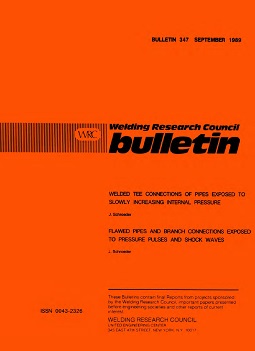
Part 1: Welded Tee Connections Of Pipes Exposed To Slowly Increasing Internal Pressure
Burst pressure data available in the literature from 1939 to 1982 for welded tee connections of pipes have been correlated using both the thickness ratios and diameter ratios of branch and run pipe. The correlation indicates that a variation of burst pressure is weak with thickness ratios for constant diameter ratios but significant with diameter ratios for constant thickness ratios but only when the thickness ratio increases toward one.
Part 2: Flawed Pipes And Branch Connections Exposed To Pressure Pulses And Shock Waves
This work represents preliminary findings of limited experimentation to test the leak-before-break criterion as the rate of pressure change increases for pipes with natural defects. Dynamic pressure variations of shock waves appear to rupture these pipes but only when applied at internal pressures above the limit pressure and to pipes with substantial plastic deformations in the vicinity of the cracks. Branch pipe-run pipe tee connections appear to be more vulnerable to shock waves than plain pipes, because the dynamic pressures deform plastically the region of the intersection rather than the whole run pipe. The shock waves may rupture the tees with natural crotch defects when they are applied at internal pressures which are below the limit pressure but after substantial plastic deformations only. The work indicates also that crack growth may be monitored by strain gages which are attached on the outer surface across a crack. Furthermore, the pressure variations of shock waves appear to depend on whether or not the material response to the wave is elastic or plastic.
| File Size : | 1
file
, 2.1 MB |
| Note : | This product is unavailable in Ukraine, Russia, Belarus |
| Number of Pages : | 31 |
| Published : | 1989 |