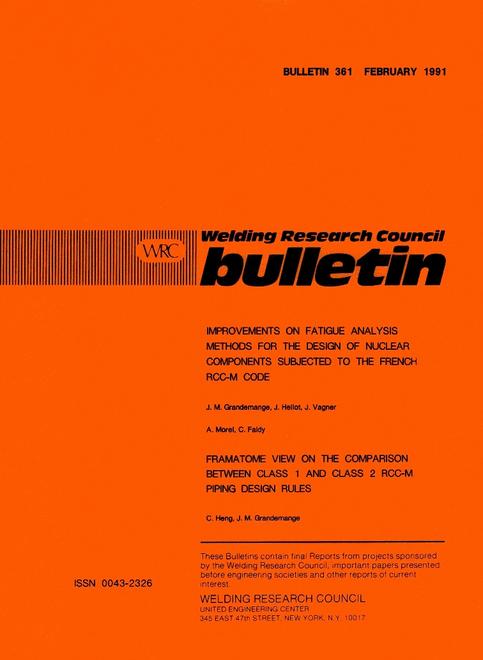
Part 1: Improvements On Fatigue Analysis Methods For The Design Of Nuclear Components Subjected To The French RCC-M Code
This paper presents the studies made for preparing the evolution of the French RCC-M Pressure Vessel Code dealing with Fatigue analysis methods.
Fatigue analyses shall use strain corrections applied to elastic analyses when plasticity occurs. These corrections may concern:
- Poisson's ratio variation when plasticity occurs,
- elastic follow-up effects,
- strain concentrations in minor discontinuities.
In many cases, these various effects may act simultaneously, leading to a need for a global logical approach including the contribution of all of them.
The aim of the paper is to present such an approach, and to give the results of its application in representative geometrical configurations subjected to realistic combined loadings including pressure, external loads and thermal effects.
These results are compared to those obtained using detailed elastic-plastic analyses taken as reference. Conclusions are given on the respective degree of conservatism of the proposed approach compared to the other available (ASME and RCC-MR) proposals.
Part 2: Framatome View On The Comparison Between Class 1 And Class 2 RCC-M Piping Design Rules
Piping systems are made of components, whose diversity would lead to excessive analysis costs if general detailed analysis rules were used. In the RCC-M code as in the ASME code, two sets of rules are codified in B.3600 and C.3600, according to the safety class of the components, which governs the set of damage risks which shall be considered in the analysis.
The RCC-M rules are essentially based on refs. 2, 3, and 4 which were based themselves on many decades of industrial experience. The analysis of class 1 and class 2 rules shows similarities, but comparative studies have shown that their application may lead to discrepancies.
The intent of this paper is to recall the main principles of the piping design codified rules, in order to compare the approaches retained for class 1 and class 2 (and 3) components, and to avoid the mistakes which may be made when analyzing test or detailed analysis data for comparison with code rules, or derivation of specific indices used in practical applications.
| File Size : | 1
file
, 4.4 MB |
| Note : | This product is unavailable in Ukraine, Russia, Belarus |
| Number of Pages : | 32 |
| Published : | 1991 |