Name:
ASTM D7725-17 PDF
Published Date:
12/15/2017
Status:
Active
Publisher:
ASTM International
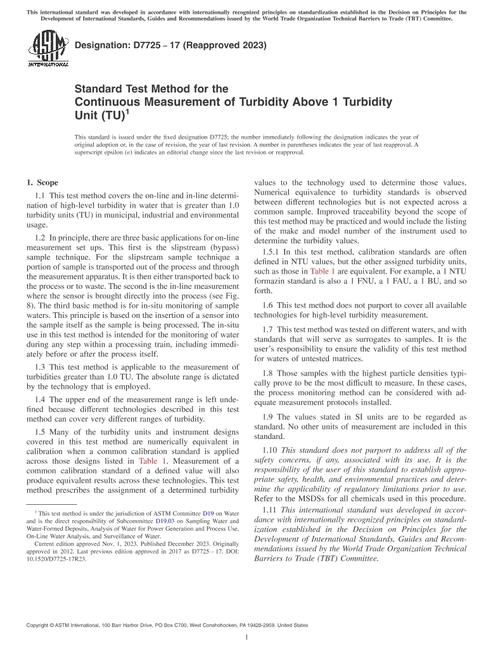
1.1 This test method covers the on-line and in-line determination of high-level turbidity in water that is greater than 1.0 turbidity units (TU) in municipal, industrial and environmental usage.
1.2 In principle, there are three basic applications for on-line measurement set ups. This first is the slipstream (bypass) sample technique. For the slipstream sample technique a portion of sample is transported out of the process and through the measurement apparatus. It is then either transported back to the process or to waste. The second is the in-line measurement where the sensor is brought directly into the process (see Fig. 8). The third basic method is for in-situ monitoring of sample waters. This principle is based on the insertion of a sensor into the sample itself as the sample is being processed. The in-situ use in this test method is intended for the monitoring of water during any step within a processing train, including immediately before or after the process itself.
1.3 This test method is applicable to the measurement of turbidities greater than 1.0 TU. The absolute range is dictated by the technology that is employed.
1.4 The upper end of the measurement range is left undefined because different technologies described in this test method can cover very different ranges of turbidity.
1.5 Many of the turbidity units and instrument designs covered in this test method are numerically equivalent in calibration when a common calibration standard is applied across those designs listed in Table 1. Measurement of a common calibration standard of a defined value will also produce equivalent results across these technologies. This test method prescribes the assignment of a determined turbidity values to the technology used to determine those values. Numerical equivalence to turbidity standards is observed between different technologies but is not expected across a common sample. Improved traceability beyond the scope of this test method may be practiced and would include the listing of the make and model number of the instrument used to determine the turbidity values.
1.5.1 In this test method, calibration standards are often defined in NTU values, but the other assigned turbidity units, such as those in Table 1 are equivalent. For example, a 1 NTU formazin standard is also a 1 FNU, a 1 FAU, a 1 BU, and so forth.
1.6 This test method does not purport to cover all available technologies for high-level turbidity measurement.
1.7 This test method was tested on different waters, and with standards that will serve as surrogates to samples. It is the user's responsibility to ensure the validity of this test method for waters of untested matrices.
1.8 Those samples with the highest particle densities typically prove to be the most difficult to measure. In these cases, the process monitoring method can be considered with adequate measurement protocols installed.
1.9 The values stated in SI units are to be regarded as standard. No other units of measurement are included in this standard.
1.10 This standard does not purport to address all of the safety concerns, if any, associated with its use. It is the responsibility of the user of this standard to establish appropriate safety, health, and environmental practices and determine the applicability of regulatory limitations prior to use. Refer to the MSDSs for all chemicals used in this procedure.
1.11 This international standard was developed in accordance with internationally recognized principles on standardization established in the Decision on Principles for the Development of International Standards, Guides and Recommendations issued by the World Trade Organization Technical Barriers to Trade (TBT) Committee.
| File Size : | 1 file , 1.1 MB |
| Note : | This product is unavailable in Russia, Ukraine, Belarus |
| Number of Pages : | 23 |
| Published : | 12/15/2017 |
| Redline File Size : | 2 files , 2.8 MB |