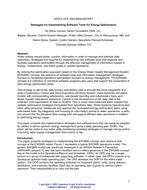
Cationic polymer doses were reduced at two East Bay Municipal Utility District
(EBMUD) treatment plants based on prior work conducted at the District indicating that
the diallyldimethylammonium chloride (DADMAC) cationic polymer was a significant
source of N-nitrosodimethylamine (NDMA) precursors. Recycled filter backwash
supernatant was a significant source of NDMA precursors, possibly due to residual
cationic polymer. When filtered water was chloraminated with chlorine and ammonia
added simultaneously (in batch samples), elevated NDMA concentrations were formed
during recycle. When filtered water was free chlorinated first (in batch samples) this
recycle stream did not form increased NDMA concentrations. Distribution system
monitoring trends were consistent with expectations based on prior experimental results.
NDMA concentrations in the chloraminated distribution system decreased when the
cationic polymer doses at two treatment plants were decreased. Out of five distinct
treatment and distribution service areas operated by the District, the lowest concentrations
of NDMA were observed in the service areas that receive water coagulated at low
polymer doses, without the input of filter backwash recycle.
Ammonia, nitrite and nitrate did not form NDMA with DADMAC; a chloramine residual
was necessary for significant levels of NDMA to be formed. This would indicate that
nitrification in the distribution system is not likely to contribute to NDMA formation for
the current precursor material. Includes 6 references, tables, figures.
| Edition : | Vol. - No. |
| File Size : | 1
file
, 320 KB |
| Note : | This product is unavailable in Ukraine, Russia, Belarus |
| Number of Pages : | 11 |
| Published : | 06/15/2003 |