AWWA ACE61806 PDF

AWWA ACE61806 PDF

Name:
AWWA ACE61806 PDF

Published Date:
06/17/2005

Status:
Active

Description:

Contribution of Wastewater to DBP Formation

Publisher:
American Water Works Association

Document status:
Active

Format:
Electronic (PDF)

Delivery time:
10 minutes

Delivery time (for Russian version):
200 business days

SKU:

Choose Document Language:
$7.2
Need Help?
This paper is part of an ongoing study to evaluate how wastewater-derived disinfection byproducts (DBPs) and their precursors contribute to DBPs in drinking water. Specifically, this paper presents a field survey of many different types of wastewater treatment plants which documents that they are sources of halogenated DBPs, if chlorine disinfection is practiced, and DBP precursors in all cases. Because the level of ammonia in treated wastewater usually is high, the addition of chlorine typically forms combined chlorine (chloramines), which minimizes the instantaneous formation of most halogenated DBPs. However, nitrosamines (e.g, N-nitrosodimethylamine [NDMA]) often are formed. Treated wastewater contains residual drinking water natural organic matter (NOM). Although the dissolved organic carbon (DOC) concentration of the effluent organic matter (EfOM) is relatively high compared to drinking water, the humic content of the EfOM (based on specific ultraviolet absorbance (SUVA))is relatively low. Waters low in SUVA tend to be less reactive with chlorine and typically form less trihalomethanes (THMs) and other DBPs per unit DOC. The presence of THM precursors and, in some cases, haloacetic acid precursors correlates best with SUVA. Preliminary data suggest that the formation of certain nitrogenous DBPs (e.g., haloacetonitriles and nitrosamines) or the presence of their precursors in treated wastewater is significant. The presence of precursors for some nitrogenous DBPs correlates with the level of dissolved organic nitrogen. Includes 32 references, tables, figures.
Edition : Vol. - No.
File Size : 1 file , 1.6 MB
Note : This product is unavailable in Ukraine, Russia, Belarus
Number of Pages : 19
Published : 06/17/2005

History


Related products

AWWA ACE61609
Published Date: 06/17/2005
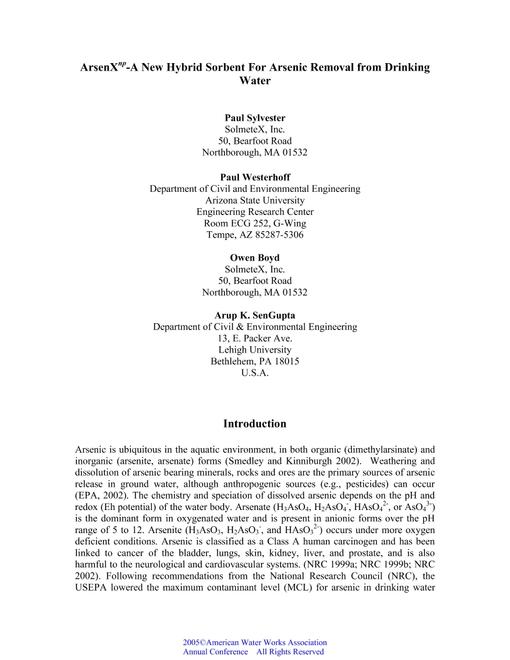
ArsenXnp-A New Hybrid Sorbent for Arsenic Removal from Drinking Water
$7.2
AWWA ACE61615
Published Date: 06/17/2005
Commissioning Of New Residuals Handling Facilities At a Direct Filtration Plant in Phoenix, Arizona
$7.2
AWWA ACE61629
Published Date: 06/17/2005
Monitoring Locations and Sampling Capabilities for Distribution System Reservoirs
$7.2
AWWA ACE61646
Published Date: 06/17/2005
Colorado Statewide Water Supply Initiative
$7.2

Best-Selling Products

IEEE/ISO 10857-1994
Published Date: 04/27/1994
ISO/IEC/IEEE International Standard - Information Technology -- Microprocessor Systems -- Futurebus+(R) - Logical Protocol specification
$80.7
IEEE/ISO 11073-10101:2004/Amd 1:2017
Published Date: 10/01/2017
Health informatics -- Point-of-care medical device communication -- Part 10101: Nomenclature/Amd 1:2017
IEEE/ISO 11073-10101-2004/Amd 1-2017
Published Date: 03/26/2018
ISO/IEEE International Standard - Health informatics -- Point-of-care medical device communication -- Part 10101: Nomenclature AMENDMENT 1: Additional definitions
$47.7
IEEE/ISO 11073-10101-2004
Published Date: 12/15/2004
ISO/IEEE Health informatics -- Point-of-care medical device communication -- Part 10101: Nomenclature
$129.3
IEEE/ISO 11073-10101-2020
Published Date: 08/28/2020
ISO/IEEE International Standard - Health informatics-Device interoperability-Part 10101: Point-of-care medical device communication-Nomenclature
$108
IEEE/ISO 11073-10206-2024
Published Date: 08/07/2024
ISO/IEEE International Standard--Health informatics--Device interoperability--Part 10206: Personal health device communication--Abstract content information model
$31.8