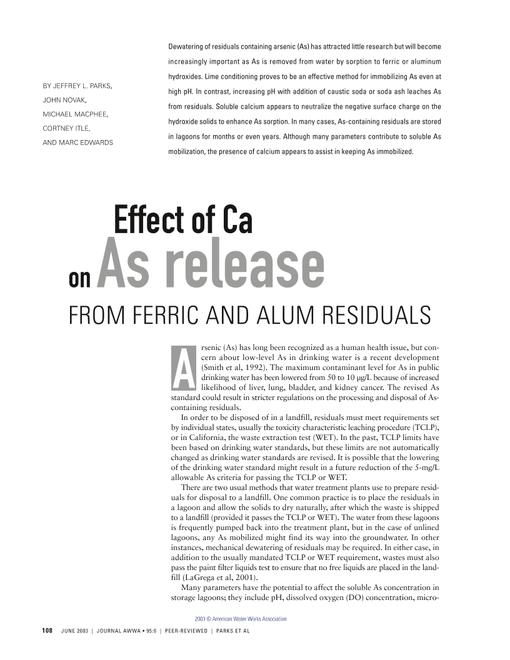
Utilities that treat water containing high concentrations
of arsenic (As) face the challenge of preventing
As mobilization from residuals. Some
treatment plants prepare residuals for disposal to a
landfill by placing them in a lagoon and allowing the
solids to dry naturally over months or even years.
Other utilities use mechanical dewatering to remove
water from residuals. In either case, the As in drying
ponds must be immobilized to protect public health
and prevent recontamination of water sources with
As through leakage or infiltration. Furthermore,
before residuals can be disposed of in a landfill, they
must meet individual state requirements. This study
provides insight into the mechanisms of As immobilization,
specifically the mechanism by which calcium
(Ca) prevents As release. Bench-scale lagoon tests
were conducted on residuals from treatment plants.
Results indicated that many parameters contribute to
soluble As mobilization, but Ca in the form of lime
may prove to be an effective method that water suppliers
can use to immobilize As in ferric and alum
residuals. Includes 15 references, tables, figures.
| Edition : | Vol. 95 - No. 6 |
| File Size : | 1
file
, 320 KB |
| Note : | This product is unavailable in Ukraine, Russia, Belarus |
| Number of Pages : | 11 |
| Published : | 06/01/2003 |