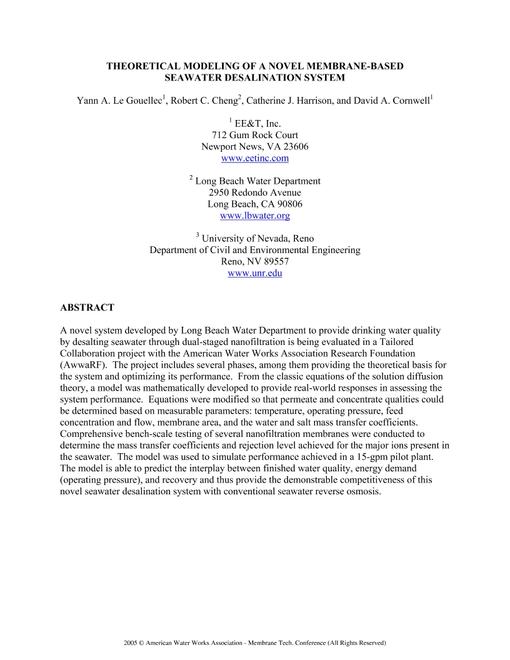
A novel system developed by the Long Beach Water Department to provide drinking water quality
by desalting seawater through dual-staged nanofiltration is being evaluated in a Tailored
Collaboration project with the American Water Works Association Research Foundation
(AwwaRF). The project includes several phases, among them providing the theoretical basis for
the system and optimizing its performance. From the classic equations of the solution diffusion
theory, a model was mathematically developed to provide real-world responses in assessing the
system performance. Equations were modified so that permeate and concentrate qualities could
be determined based on measurable parameters: temperature, operating pressure, feed
concentration and flow, membrane area, and the water and salt mass transfer coefficients.
Comprehensive bench-scale testing of several nanofiltration membranes were conducted to
determine the mass transfer coefficients and rejection level achieved for the major ions present in
the seawater. The model was used to simulate performance achieved in a 15-gpm pilot plant.
The model is able to predict the interplay between finished water quality, energy demand
(operating pressure), and recovery and thus provide the demonstrable competitiveness of this
novel seawater desalination system with conventional seawater reverse osmosis. Includes 3 references, table, figures.
| Edition : | Vol. - No. |
| File Size : | 1
file
, 430 KB |
| Note : | This product is unavailable in Ukraine, Russia, Belarus |
| Number of Pages : | 9 |
| Published : | 03/01/2005 |