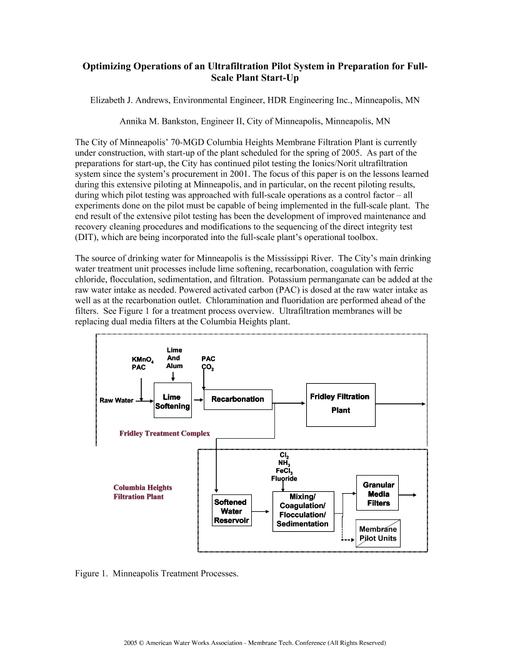
The City of Minneapolis' 70-MGD Columbia Heights Membrane Filtration Plant is currently
under construction, with start-up of the plant scheduled for the spring of 2005. As part of the
preparations for start-up, the City has continued pilot testing the Ionics/Norit ultrafiltration
system since the system's procurement in 2001. The focus of this paper is on the lessons learned
during this extensive piloting at Minneapolis, and in particular, on the recent piloting results,
during which pilot testing was approached with full-scale operations as a control factor. All
experiments done on the pilot must be capable of being implemented in the full-scale plant. The
end result of the extensive pilot testing has been the development of improved maintenance and
recovery cleaning procedures and modifications to the sequencing of the direct integrity test
(DIT), which are being incorporated into the full-scale plant's operational toolbox. The extensive piloting effort at Minneapolis following procurement has afforded the City the
opportunity to identify and troubleshoot potential operational issues and make necessary
modifications into the plant design. Such issues can be difficult to identify during short-duration
pilot testing (used for the purposes of procurement), particularly with the dynamic nature of
surface water quality throughout the course of a year. For the Columbia Heights Membrane Plant
pilot units, three primary issues were identified during post-procurement pilot testing:
what is the "clean" membrane permeability and what is a reasonable
permeability to sustain during normal operation;
fouling of the membrane system starting in the spring, during the snow
melt run-off period and lasting sometimes into fall; and,
the impacts of the direct integrity test (DIT) on the membrane
permeability. Includes reference, table, figures.
| Edition : | Vol. - No. |
| File Size : | 1
file
, 600 KB |
| Note : | This product is unavailable in Ukraine, Russia, Belarus |
| Number of Pages : | 4 |
| Published : | 03/01/2005 |