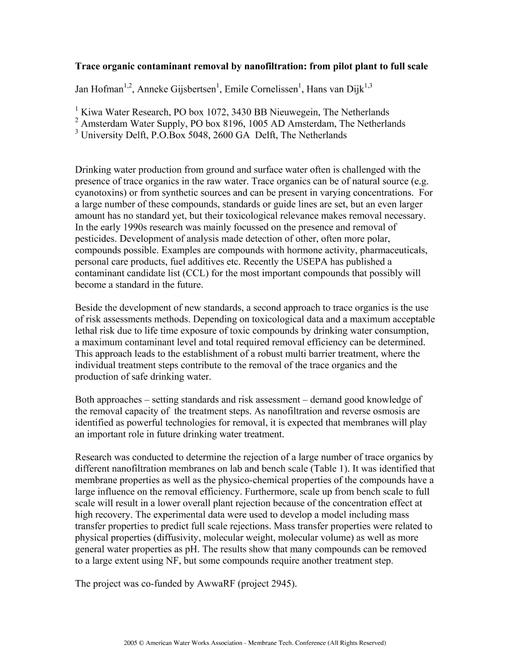
This is an extended abstract only of a project co-funded by American Water Works Association Research Foundation, Project #2945, that involved determining the rejection of a large number of trace organics by
different nanofiltration (NF) membranes on lab and bench scale. It was identified that
membrane properties as well as the physico-chemical properties of the compounds have a
large influence on the removal efficiency. Furthermore, scale up from bench scale to full
scale will result in a lower overall plant rejection because of the concentration effect at
high recovery. The experimental data were used to develop a model including mass
transfer properties to predict full scale rejections. Mass transfer properties were related to
physical properties (diffusivity, molecular weight, molecular volume) as well as more
general water properties as pH. The results show that many compounds can be removed
to a large extent using NF, but some compounds require another treatment step. Includes table, figures.
| Edition : | Vol. - No. |
| File Size : | 1
file
, 320 KB |
| Note : | This product is unavailable in Ukraine, Russia, Belarus |
| Number of Pages : | 3 |
| Published : | 03/01/2005 |