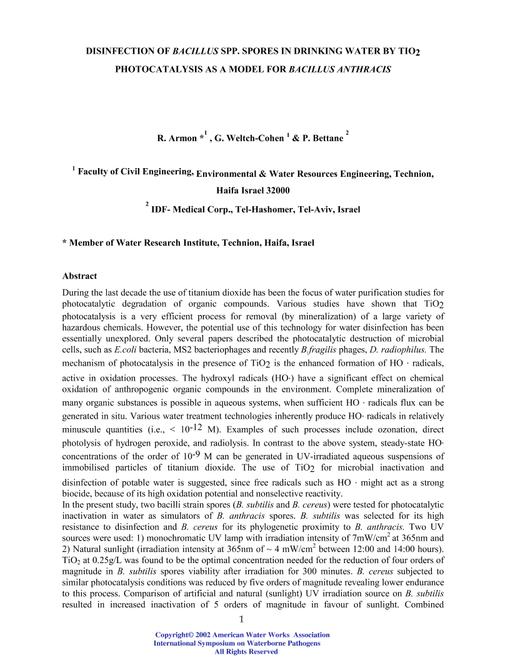
During the last decade the use of titanium dioxide has been the focus of water purification studies for
photocatalytic degradation of organic compounds. Various studies have shown that TiO2
photocatalysis is a very efficient process for removal (by mineralization) of a large variety of
hazardous chemicals. However, the potential use of this technology for water disinfection has been
essentially unexplored. Only several papers described the photocatalytic destruction of microbial
cells, such as E.coli bacteria, MS2 bacteriophages and recently B.fragilis phages, D. radiophilus.
In this study, two bacilli strain spores (B. subtilis and B. cereus) were tested for photocatalytic
inactivation in water as simulators of B. anthracis spores. B. subtilis was selected for its high
resistance to disinfection and B. cereus for its phylogenetic proximity to B. anthracis. Two ultraviolet (UV)
sources were used: a monochromatic UV lamp with an irradiation intensity of 7mW/cm2 at 365nm; and,
natural sunlight (irradiation intensity at 365nm of ~ 4 mW/cm2 between 12:00 and 14:00 hours).
TiO2 at 0.25g/L was found to be the optimal concentration needed for the reduction of four orders of
magnitude in B. subtilis spores viability after irradiation for 300 minutes. B. cereus subjected to
similar photocatalysis conditions was reduced by five orders of magnitude revealing lower endurance
to this process. Comparison of artificial and natural (sunlight) UV irradiation source on B. subtilis
resulted in increased inactivation of 5 orders of magnitude in favor of sunlight. Combined
inactivation by photocatalytic process (UV 365nm) and detrimental activity of UV at 265nm can
explain this result. There was no difference between the two irradiation sources when B. cereus was
tested. Under both irradiation types, B. cereus was reduced by four orders of magnitude during 300
minutes time interval. Additional experiments including TiO2 concentration, irradiation intensity,
water depth, initial spore number, etc. were performed.
Taking into account that B. anthracis spores have hydrophobic properties, the photocatalytic process
seems to be the method of choice in water disinfection eliminating the possibility of byproducts
formation such as halogens.
Includes 19 references, table, figures.
| Edition : | Vol. - No. |
| File Size : | 1
file
, 220 KB |
| Note : | This product is unavailable in Ukraine, Russia, Belarus |
| Number of Pages : | 12 |
| Published : | 09/22/2002 |