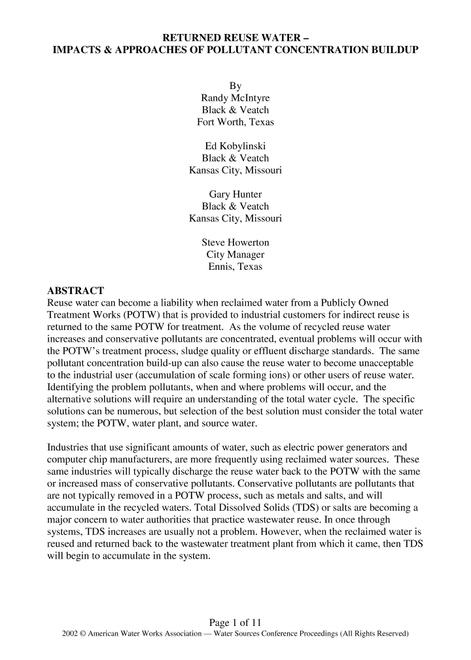
Reuse water can become a liability when reclaimed water from a Publicly Owned Treatment Works (POTW) that is provided to industrial customers for indirect reuse is returned to the same POTW for treatment. As the volume of recycled reuse water increases and conservative pollutants are concentrated, eventual problems will occur with the POTW's treatment process, sludge quality or effluent discharge standards. The same pollutant concentration build-up can also cause the reuse water to become unacceptable to the industrial user (accumulation of scale forming ions) or other users of reuse water. Identifying the problem pollutants, when and where problems will occur, and the alternative solutions will require an understanding of the total water cycle. The specific solutions can be numerous, but selection of the best solution must consider the total water system; the POTW, water plant, and source water. Industries that use significant amounts of water, such as electric power generators and computer chip manufacturers, are more frequently using reclaimed water sources. These same industries will typically discharge the reuse water back to the POTW with the same or increased mass of conservative pollutants. Conservative pollutants are pollutants that are not typically removed in a POTW process, such as metals and salts, and will accumulate in the recycled waters. Total Dissolved Solids (TDS) or salts are becoming a major concern to water authorities that practice wastewater reuse. In once through systems, TDS increases are usually not a problem. However, when the reclaimed water is reused and returned back to the wastewater treatment plant from which it came, then TDS will begin to accumulate in the system. Includes figures.
| Edition : | Vol. - No. |
| File Size : | 1
file
, 170 KB |
| Note : | This product is unavailable in Ukraine, Russia, Belarus |
| Number of Pages : | 11 |
| Published : | 01/01/2002 |