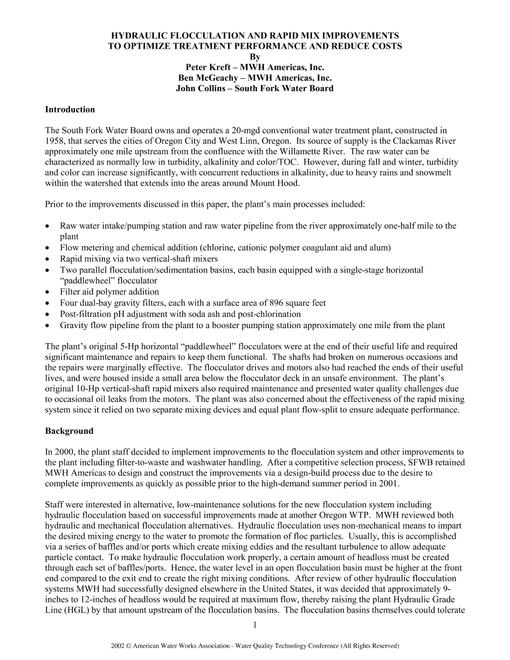
This paper demonstrates the applicability and performance of low-cost and relatively non-mechanical flocculation
and rapid mix systems at the 40-year old South Fork Water Board conventional treatment plant (that serves the cities of Oregon City and West Linn, Oregon), whose mechanical
systems were failing and in need of replacement and/or repair. Settled water quality and filter performance have
remained the same or improved since implementation of these improvements. These improvements also resulted
in long-term energy cost and O&M cost savings due to removal of mechanical systems. The selected hydraulic flocculation design incorporated the use of wooden baffle walls supported by concrete
columns which were anchored with bases into the floor of the two flocculation basins. Three rows of baffle walls
were created to force an "end around" flowpath with 3 main flocculation stages; each stage was provided with
sequentially less headloss to create tapered flocculation to promote the formation of settleable floc when needed.
Each stage was further divided into separate flocculation cells with full-depth openings to create the desired
headloss. The opening sizes increased in each stage to reduce headloss. A diffuser wall at the end of the
flocculation basin helps distribute flow evenly into the sedimentation basin across the width and depth.
| Edition : | Vol. - No. |
| File Size : | 1
file
, 210 KB |
| Note : | This product is unavailable in Ukraine, Russia, Belarus |
| Number of Pages : | 3 |
| Published : | 11/01/2002 |