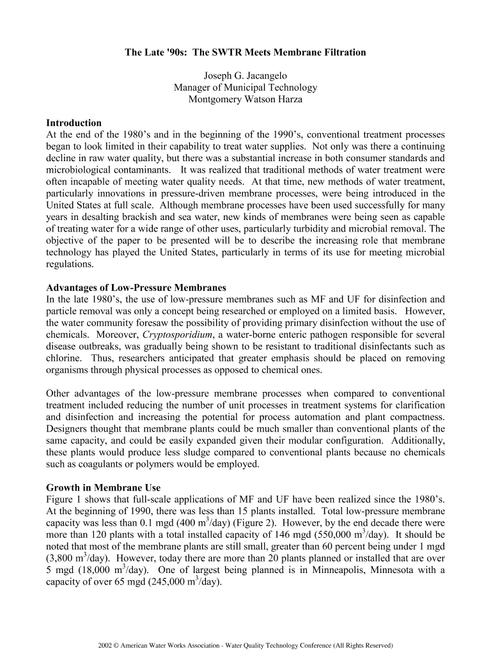
At the end of the 1980s and in the beginning of the 1990s, conventional treatment processes
began to look limited in their capability to treat water supplies. Not only was there a continuing
decline in raw water quality, but there was a substantial increase in both consumer standards and
microbiological contaminants. It was realized that traditional methods of water treatment were
often incapable of meeting water quality needs. At that time, new methods of water treatment,
particularly innovations in pressure-driven membrane processes, were being introduced in the
United States at full scale. Although membrane processes have been used successfully for many
years in desalting brackish water and seawater, new kinds of membranes were being seen as capable
of treating water for a wide range of other uses, particularly turbidity and microbial removal. The
objective of this paper was to describe the increasing role that membrane
technology has played the United States, particularly in terms of its use for meeting microbial
regulations. Topics discussed include: advantages of low-pressure membranes; growth in membrane use; disinfection as an impetus for membrane use; clarification as an impetus for membrane use; and, strategies for integration into water treatment plants.
Includes figures.
| Edition : | Vol. - No. |
| File Size : | 1
file
, 250 KB |
| Note : | This product is unavailable in Ukraine, Russia, Belarus |
| Number of Pages : | 4 |
| Published : | 11/01/2002 |